







Pool Builder
Navigating California’s 2025 Electrical Regulations for Swimming Pools
An overview of California’s electrical regulations for swimming pools, recent updates, and anticipated changes in pool safety codes.

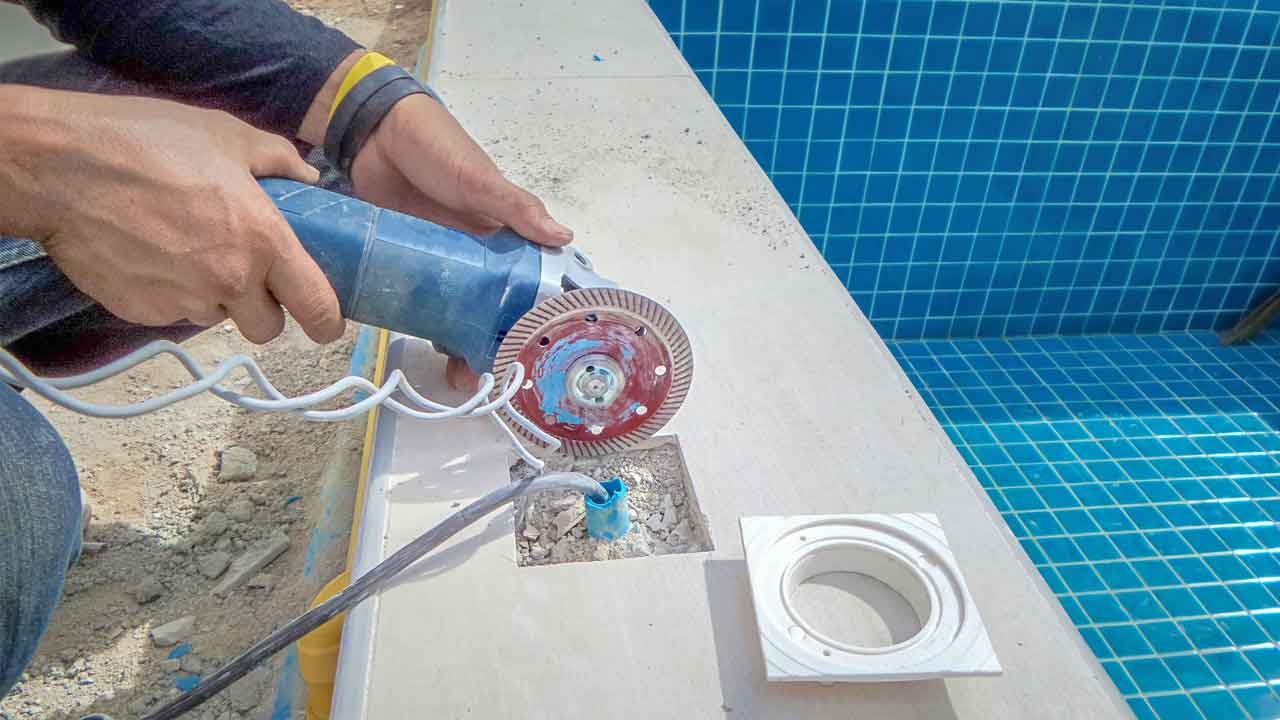
Swimming pools and spas rely on robust electrical systems to power vital components such as pumps, filters, and lighting. In 2025, California’s electrical requirements for swimming pools continue to evolve, emphasizing safety and efficiency in line with updates to the National Electrical Code (NEC) and state-specific electrical regulations. Below is an overview of the key requirements, recent updates, and anticipated changes in California’s pool safety codes.
Underground Wiring: Keeping Cables Safe
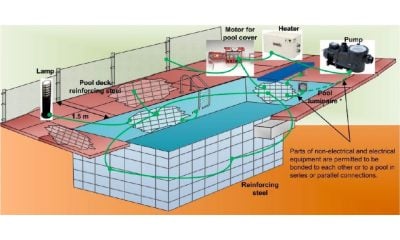
To minimize risks near water, underground wiring is prohibited directly beneath swimming pools or spas. It must be installed at least 5 feet away from the sidewalls unless specific protective measures are in place. If underground wiring is needed within this restricted zone, it must be enclosed in a continuous conduit such as Rigid Metal Conduit (RMC), Intermediate Metal Conduit (IMC), or non-metallic conduit.
These conduits require a minimum cover of 6 inches. For non-metallic conduit within 5 feet of the pool, additional encasement in at least 4 inches of concrete is necessary. Alternatively, direct burial cables may be used if rated for such purposes, requiring 18 inches of cover without concrete encasement. These measures ensure that wiring near pools is adequately protected from accidental damage or exposure to water, reducing risks of electrocution or electrical fires.

Overhead Electrical Lines: Maintaining Vertical Clearance
Overhead electrical lines near pools present a unique safety hazard. To ensure safety, communication cables must be installed at least 10 feet above the water’s surface or diving platforms. Utility power lines, which carry higher voltages, must have a minimum clearance of 22.5 feet above the pool or the highest diving platform.
These clearance measurements are taken from the maximum potential water level, including any overflow, to provide consistent safety across varying conditions. Proper vertical clearance minimizes the risk of accidental contact with live wires, which could result in serious injuries or fatalities.
Maintenance Disconnects: A Quick Safety Shutoff
Maintenance disconnects are critical safety features that allow quick and easy shutoff of power to essential pool equipment, such as pumps and filters, during emergencies or routine servicing. These disconnect switches must be installed in clear sight of the pool or spa to ensure they are easily accessible. However, they should not be placed closer than 5 feet from the water’s edge to avoid accidental operation or exposure to moisture.
In certain cases, jurisdictions may permit shorter distances if the disconnects are housed in lockable or specially enclosed panels. By providing a safe method to disable power, maintenance disconnects reduce the risk of electrical accidents during repairs or servicing.
Electrical Outlet Placement: Strategic Safety Standards
The placement of electrical outlets around pools is carefully regulated to prevent potential hazards. General-use outlets that are not protected by Ground-Fault Circuit Interrupters (GFCI) must be positioned at least 20 feet away from pools. In contrast, GFCI-protected outlets can be installed as close as 6 feet to the water’s edge, as they offer additional safety by automatically cutting off power when imbalances are detected.

Outlets specifically designated for pumps and motors must be located between 6 and 10 feet from pool walls, equipped with GFCI protection, and covered with weatherproof locking covers to ensure safety in all conditions. For in-ground pools, at least one GFCI-protected outlet must be installed within 6 to 10 feet of the pool edge to meet compliance standards.
GFCI Protection: A Life-Saving Technology
GFCI devices are integral to pool safety, as they prevent electrical shocks by shutting off power when they detect an imbalance. Heading into 2025, GFCI protection is required for all underwater pool lights exceeding 15 volts, electrical outlets within 20 feet of pools or spas, and light fixtures located within 10 feet of the water’s edge unless they are elevated at least 5 feet above the waterline.
Pool cover motors and other electrical equipment, such as pump motors, are also required to have GFCI protection. With advancements in safety standards, California is expanding the application of GFCIs, further enhancing protection for pool users and maintenance personnel.
Self-Contained Spas and Hot Tubs: Special Rules
Spas and hot tubs have unique electrical requirements due to their compact design and proximity to water. Ceiling fixtures above spas must be installed at least 12 feet from the water’s surface. However, fixtures equipped with GFCI protection may be placed as low as 10 feet. Wall switches must remain at least 5 feet away from the spa waterline to prevent accidental contact with water.
Electrical outlets serving spas must also adhere to strict guidelines. Outlets within 10 feet of the spa require GFCI protection, while those placed closer than 6 feet must utilize specially approved barriers or enclosures to ensure safety.
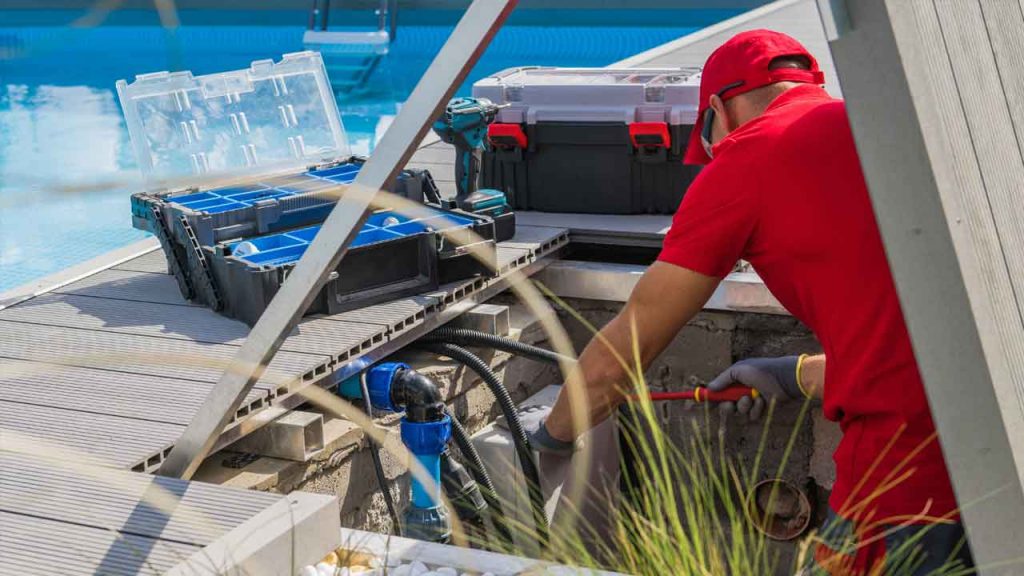
California-Specific Updates and Legislative Actions
California’s pool safety regulations have undergone several legislative updates in recent years. SB-442, enacted in 2018, requires residential pools to implement safety measures such as fences, alarms, or self-closing gates. These requirements were extended in 2022 to cover all single-family homes, eliminating previous municipal opt-outs.
Additionally, California enforces federal standards for drain covers to prevent entrapment hazards, ensuring that all pools and spas utilize compliant equipment. Looking ahead, California’s Title 24 Building Standards Code is expected to incorporate updates from the 2023 NEC, potentially bringing additional GFCI requirements and energy efficiency measures. Contractors and homeowners should monitor these changes closely, as they may take effect as early as 2025 in some jurisdictions.
NEC Adoption Trends Across the U.S.
While California remains on the 2017 NEC, other states are progressively adopting newer editions of the code. The 2020 NEC has been implemented in states like Texas, Washington, and Colorado, while some jurisdictions still adhere to older versions, such as the 2014 NEC. Arizona, Illinois, and Missouri, which do not mandate statewide NEC adoption, rely on local jurisdictions for electrical standards. As more states transition to the 2023 NEC, pool builders and electricians operating across state lines must stay informed about regional variations to ensure compliance.

Electrical Regulations for Swimming Pools in California
Below is a data table organizing the key points by category for the electrical regulations for swimming pools in California (2025):
| Category | Key Points |
|---|---|
| Underground Wiring | – Wiring must not be directly beneath pools or spas. – Maintain a minimum of 5 feet distance from pool walls unless protected. – RMC or IMC requires at least 6 inches of cover. – Non-metallic conduit also requires 6 inches of cover but must have 4 inches of concrete if within 5 feet. – Direct burial cables require 18 inches of cover if rated for such use. |
| Overhead Electrical Lines | – Communication cables must be at least 10 feet above the water’s surface. – Utility power lines must maintain 22.5 feet clearance above the water or diving platforms. – Measurements consider maximum potential water levels, including overflow. |
| Maintenance Disconnects | – Must provide quick power shutoff for pool equipment. – Located in clear sight of the pool or spa. – Must be at least 5 feet away from the water’s edge. – Shorter distances allowed if housed in lockable or enclosed panels. |
| Electrical Outlets | – Non-GFCI outlets must be at least 20 feet from pools. – GFCI-protected outlets can be installed as close as 6 feet. – Pump and motor outlets must be located 6 to 10 feet from the pool wall. – In-ground pools require at least one GFCI outlet within 6 to 10 feet of the pool edge. |
| GFCI Protection | – Required for underwater pool lights exceeding 15 volts. – Mandatory for outlets within 20 feet of pools or spas. – Required for light fixtures within 10 feet unless elevated 5 feet above water. – Necessary for pool pump motors and cover motors. |
| Self-Contained Spas and Hot Tubs | – Ceiling fixtures must be installed at least 12 feet above the spa. – GFCI-protected fixtures may be installed at 10 feet. – Wall switches must remain at least 5 feet from the spa waterline. – Outlets within 10 feet require GFCI protection, with special barriers required for outlets closer than 6 feet. |
| California-Specific Updates | – SB-442 mandates safety features like fences, alarms, or self-closing gates. – Federal drain cover standards enforced to prevent entrapment hazards. – Title 24 updates expected to include new GFCI and energy efficiency standards in line with 2023 NEC. – Monitor local jurisdictions for early enforcement of standards. |
| NEC Adoption Trends | – California adheres to 2017 NEC but is expected to transition to 2023 NEC. – Other states like Texas and Colorado have adopted the 2020 NEC. – Some states rely on local jurisdictions for code updates (e.g., Arizona, Illinois). |
Key Takeaways for 2025
As safety rules for swimming pools and spas continue to evolve, compliance with California’s stringent electrical regulations is essential. Planning construction projects with anticipated code changes in mind can save time and ensure future compliance. Homeowners and contractors should work with licensed electricians who are knowledgeable about the latest NEC updates and local amendments. Additionally, staying informed about upcoming changes to California’s Title 24 and other safety standards is crucial for maintaining compliance. By adhering to these guidelines, pool owners and industry professionals can create safer, more reliable pool environments that meet the highest standards of safety and efficiency.
References
- California Building Standards Commission (CBSC)
https://www.dgs.ca.gov/BSC - California Electrical Code (CEC)
https://www.dgs.ca.gov/BSC/ - National Fire Protection Association (NFPA) – 2023 National Electrical Code (NEC)
https://www.nfpa.org/NEC - California Department of General Services (DGS)
https://www.dgs.ca.gov/









Pool Builder
Tenex Capital Management Acquires Pool Builder Franchisor, Blue Haven National Management Inc.

New York, NY – December 3, 2025 – Tenex Capital Management (“Tenex”) is pleased to announce an investment in Blue Haven National Management, Inc. (“Blue Haven” or “The Company”), a 71-year-old franchisor of swimming pool builders.
Headquartered in San Diego, CA, Blue Haven is believed to be the 2nd largest residential-focused pool builder franchisor in the United States. With 60+ locations nationally, Blue Haven is one of the most recognized brands in the pool industry. Blue Haven will continue to be run by Ryan Ripley, President/CEO and Matt Kimball, COO.
Blue Haven CEO, Ryan Ripley, commented, “We were very impressed by Tenex’s experience and network in the pool space and other similar industries. They offer extensive operational expertise and are poised to support our efforts in expanding our footprint by enabling us to better service existing and new franchisees. We have spent the past couple of years developing new technology for pool builders that is designed to improve the customer experience, and we believe Tenex will be a valuable partner as we continue to develop and implement Blue Haven’s offerings.”

Blue Haven COO, Matt Kimball stated, “Tenex provides the capital and resources that we believe will support our growth plans. We expect this partnership to help us move more quickly and make targeted investments for the benefit of our franchisee base and other stakeholders.”
Tenex Managing Director, Gabe Wood, remarked, “We are thrilled to partner with the Blue Haven management team & franchise operators. We look forward to providing marketing and technology support, as well as other capabilities that will allow Blue Haven to pursue their strategic and operational objectives to drive sustainable growth for this respected brand.”
The transaction closed on November 26th, 2025.
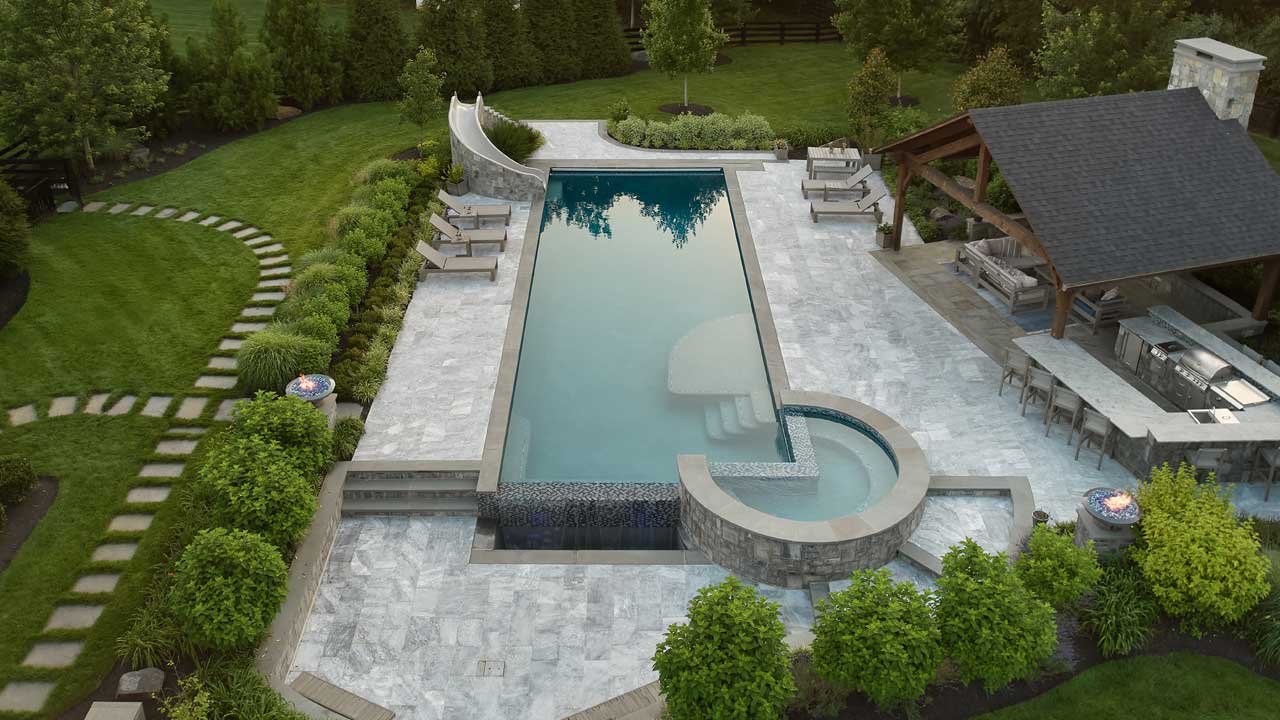
A client approached Rockwater Farm Landscapes & Hardscapes with a unique request: design a luxury backyard pool and spa that incorporated an autocover system. For many designers, that detail might have been a limitation, but for Todd Thomasson, owner of Rockwater Farm, it became the spark for something original. Rather than compromise the spa design, he treated the challenge as an opportunity to elevate the overall aesthetic. The result is a one-of-a-kind “Pac-Man” style spa that delivers both functionality and a striking focal point for the backyard.
A Philosophy of Unique Design
For Thomasson, every project begins with the belief that no two backyards should ever look the same. “We simply don’t build the same thing twice,” he explained. “Even if it’s another 20 by 40 pool, the backyard, the access, the elevations—all of it is different. Every time is the first time for us, and that’s what makes design exciting”.
This philosophy extends beyond pools. Founded nearly two decades ago, Rockwater Farm began as a landscaping company rooted in Thomasson’s background as a trained stonemason. Over the years, the company evolved to specialize in complete outdoor environments—pools, pavilions, fireplaces, outdoor kitchens, and landscape integration. That holistic approach ensures projects flow seamlessly, with one point of accountability and a vision that unifies all elements of the backyard.

Setting the Stage for Something Different
Like many of Rockwater Farm’s most memorable projects, this one began with a relationship. The homeowners had been long-time maintenance clients, trusting the company with their property care for years. When they purchased a new home in a growing neighborhood, they wanted more than just a functional backyard — they envisioned a place to entertain, gather, and enjoy with family.
The project unfolded in phases. First came a patio, outdoor kitchen, and pergola connected to the house — all designed and built by Thomasson’s team. But those elements were only part of a bigger dream. From the start, the homeowners knew a pool and spa would eventually complete the space. The question wasn’t if, but how.
The “Pac-Man” Spa
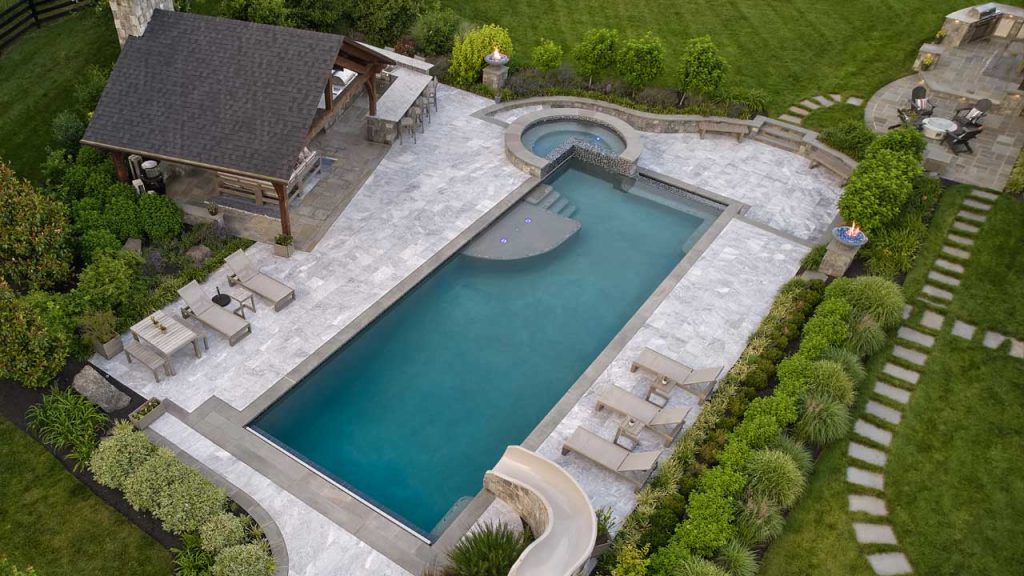
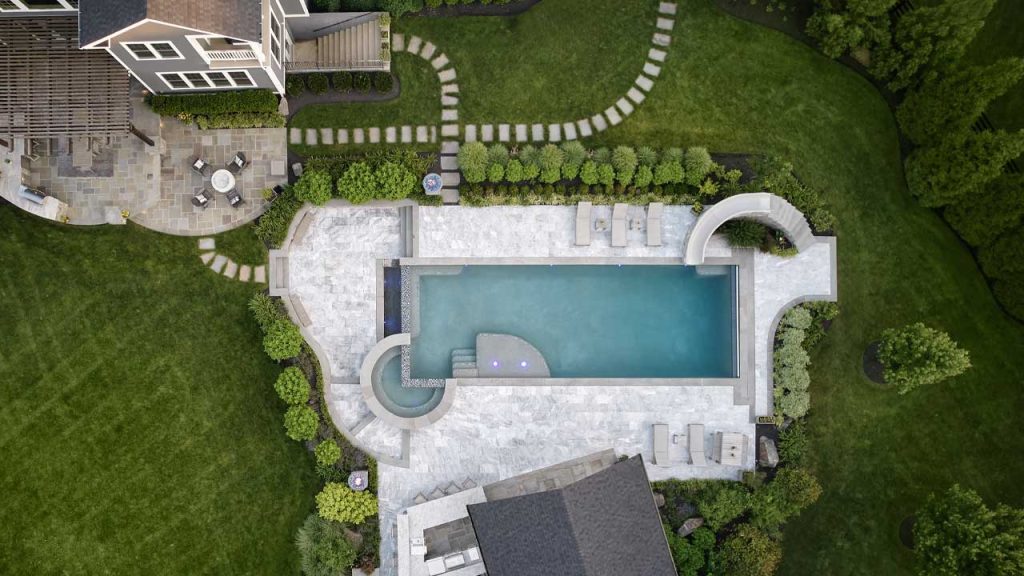
When it came time to plan the pool and reconcile the client’s desire for an autocover, Thomasson faced a design puzzle. The cover system required uninterrupted space at one end of the pool, which conflicted with traditional spa placement. Rather than forcing a compromise, he cut a quarter out of the spa and turned it into a design opportunity.
“I didn’t want the typical spa on the side of the pool that spills in. Those are dime a dozen,” said Thomasson. “We’re always asking: what haven’t we done, or what can we pull from different projects to create something unique? This became what we call a crow’s nest of a spa, perched up on the corner of the pool. Because of the shape, it ended up looking like Pac-Man”.
The cut-out serves multiple purposes. It creates a clean line for the autocover to function, ensures no one has their back to the pool—a safety consideration—and frames the water in a striking way. “By taking out that piece, we kept visibility of the water as a priority. Everyone in the spa is still looking across the pool, not away from it,” he explained.
A Balance of Safety and Style
Safety wasn’t an afterthought. For Thomasson, it was ingrained in the design process. He recalled his own childhood experiences as part of the inspiration: “I grew up with a pool. My mom was a school teacher, sitting on the deck with a whistle. That always stuck with me—the importance of seeing the water. It’s something I think about in every project”.
In this way, the spa design became both functional and symbolic. It respected the client’s need for safety, maintained visual oversight of the water, and at the same time became a distinctive element that elevated the project’s sophistication.
Material Selections That Complement the Design
The pool’s elegance extends beyond its shape. Every material was selected with care. Around the pool, Thomasson used marble decking with a sandblasted finish, chosen for its comfort and practicality. “It doesn’t get hot underfoot like flagstone, pavers, or even concrete. At the same time, it provides grip, so it’s safe as well as beautiful”.
The pavilion, angled to enhance views from the house, introduces a rustic counterpoint with Pennsylvania flagstone underfoot and heavy timber framing overhead. “Everything on this project is natural stone. We don’t really do pavers. I’m biased as a former stonemason, but I believe it’s a better product. It holds up, and it looks timeless,” Thomasson said.
The interior finish of the pool is a darker blue plaster, selected for both aesthetic and practical reasons. It reflects light beautifully and helps maintain water temperature, creating shimmering, reflective tones that change with the sky.
Transitioning Spaces Through Stone
Another intentional design detail was the use of contrasting materials at transitions. “I like step treads to be a contrasting material so they stand out. If you run travertine everywhere, bright sunlight can wash out those changes and someone could trip. By mixing materials, you get safety and visual definition, while also creating a sense of arriving in a new space,” Thomasson explained.
Bringing the Backyard to Life at Night
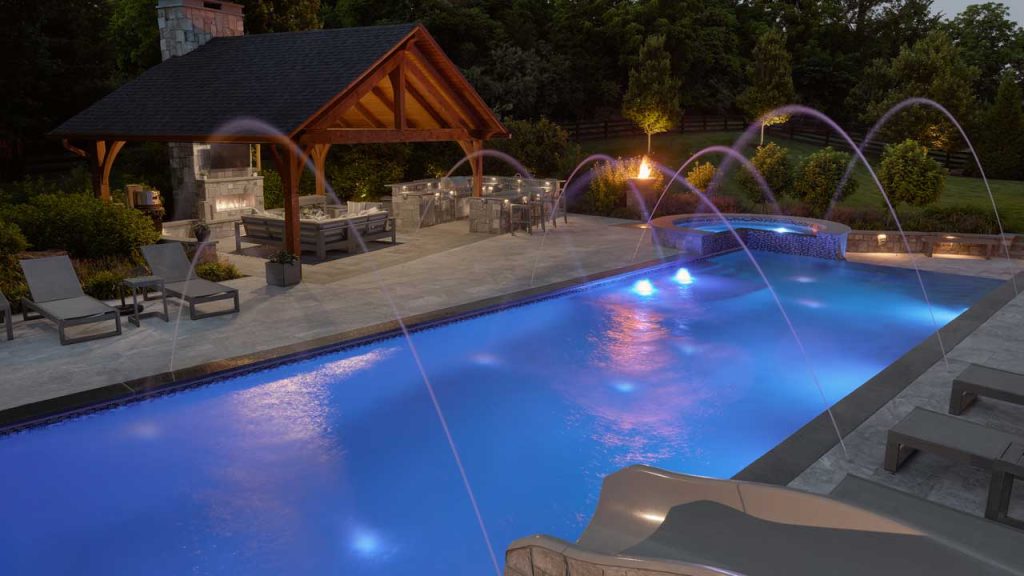
While the spa steals the show during the day, the backyard transforms into something even more dramatic after sunset. Thomasson integrated extensive lighting throughout the landscape, pavilion, and pool features. Solid granite fire bowls, gas-powered and glowing after dark, punctuate the scene. The pavilion’s fireplace adds warmth and atmosphere, while deck jets and bubblers with LED lighting create playful movement and vibrant accents.
“There’s just a lot of different activity that can happen out here. It’s not just a backyard—it’s a resort,” Thomasson said.
The Moment It All Came Together
For Thomasson, the true impact of the design hit during the project’s first photo shoot. “It really sank in when I was there at night. The lights were on, it was warm, everything came together. I just walked around and thought, ‘We actually built this. This looks awesome.’ It was one of those moments where you stop, take it in, and appreciate what you created”.
That moment of reflection underscores what makes Rockwater Farm distinctive: a blend of design ingenuity, craftsmanship, and respect for the client’s trust.
Beyond the Expected
What could have been a design obstacle—the integration of an autocover—became the genesis of one of Rockwater Farm’s most memorable projects. By embracing the challenge, Thomasson and his team produced something that is not only functional but also a signature piece of design. The Pac-Man spa represents more than a clever workaround; it reflects a philosophy of turning limitations into opportunities.
In Thomasson’s words, “Ultimately, you want something different in your portfolio. That’s how we approach design. It’s about pushing creativity while still serving the client’s needs”.
For Rockwater Farm, thinking around covers and corners has become second nature—and it shows in every detail of this unique backyard retreat.
Ready to take a deeper dive?
Listen to our entire conversation with Todd Thomasson of Rockwater Farm on the Pool Magazine Podcast.


WARMINSTER, PA, UNITED STATES, October 10, 2025 — Anthony & Sylvan Pools – the premier residential swimming pool and spa builder, renovator, and service provider in the United States – today announced that Chief Executive Officer Bonnie Chong will be stepping down after nearly eight years with the company to pursue a new opportunity in the professional services sector.
Since joining Anthony & Sylvan in 2018, Chong has held several key executive positions, including General Counsel, Chief Financial Officer, and most recently Chief Executive Officer since April 2022. During her tenure, she guided the company through the challenges of the pandemic and the post-COVID market environment while helping to strengthen its culture, built a high-performing leadership team and prepared a framework for the next phase of growth. Chong reflected, “Leading and supporting Anthony & Sylvan’s growth over the past eight years has been a true honor for me. I am grateful for what we have achieved and look forward to its continued growth and success in the years ahead.”
Chong will remain on the Anthony & Sylvan Board of Directors to support a smooth transition and continue contributing to the company’s strategy.
The Board has appointed Alan Walker, Senior Vice President of Operations, as Interim CEO, effective October 22, 2025, while a search is conducted for a permanent successor. With more than 20 years at Anthony & Sylvan, Walker brings extensive operational experience, deep industry knowledge, and strong relationships throughout the organization and the pool industry.
“Bonnie’s leadership, intellect, and integrity have guided Anthony & Sylvan through a transformative period,” said Erik Waldin, Chairman of the Board. “We are grateful for her many contributions and wish her all the best in her future endeavors. We also have full confidence in Alan’s leadership and his ability to continue the company’s positive momentum.”
About Anthony & Sylvan
Founded in 1946, Anthony & Sylvan Pools is one of the nation’s largest and most experienced swimming pool design and construction companies. In its nearly 80-year history, it has served more than a million customers throughout the U.S.
The entities doing business as Anthony & Sylvan Pools include Anthony & Sylvan Pools Corporation, Anthony & Sylvan Corp. and Anthony & Sylvan Pools North Carolina LLC. Anthony & Sylvan’s statewide licenses/registrations: #SPB.0000089 and HIC.0501976(CT); #2006201521(DE); #410512000233(DC); CPC1459629 and CPC1459777 (FL); #203008(MA); 05-129792 – Reg#95872(MD); #13VH01546700(NJ); #H-20201 and #WC22294H09(NY); #0023414(NV); #68766(NC); #006381(PA); GC-46619(RI); CLG 125269(SC); #75966(TN);13800478-5501(UT); #2701011419(VA RFC/ELE); and #WV030223(WV). FOR INFORMATION ABOUT CONTRACTORS AND THE NEW JERSEY CONTRACTORS’ REGISTRATION ACT, CONTACT THE NEW JERSEY DEPARTMENT OF LAW AND PUBLIC SAFETY, DIVISION OF CONSUMER AFFAIRS AT 1.888.656.6225.
Nicole Lasorda
Anthony & Sylvan




Download the NEW Pool Magazine App
 Sponsored Advertisement
 AquatiCare™: Proactive Pool Maintenance You Can Count On
 RB Retail & Service Solutions adds DocuSign to Software
 BSquared offers New Free Standing Sunledge
 Family Leisure Announces Exclusive Retail Partnership with Jacuzzi
  Blue Wave Recall on Over 13,000 Above Ground Pools
 Tile Heritage Foundation embraces FOUR NEW BOARD MEMBERS joining the current Board of Directors!
 Coverings 2026 Previews Conference Education Ahead of Las Vegas Show
 Ledge Lounger Announces Recapitalization Lead by Summit Park
 Baking Soda Pool Hack – Is It Real Or Is It Clickbait?
 Pentair Pool’s Annual Pool Pro Awards Open to Nominations
 Thursday Pools Adds Samantha Kuonen to Accounting Team
 The 10 Best Solar Powered Pool Skimmers
 Pool Heaters: Give Your Customers Some Pool Heat
 Water Tech Celebrates 20th Anniversary


 Sponsored Advertisement
-
 Pool News2 weeks ago
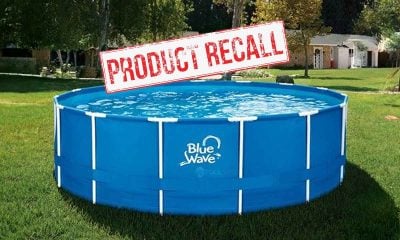
Blue Wave Recall on Over 13,000 Above Ground Pools
-

 Industry News4 weeks ago
Latham Group Appoints Sean Gadd as Chief Executive Officer
-

 News3 weeks ago
Built on Relationships: Pentair Pool’s New Sales Structure and the People Who Make It Work
-

 Pool Service News3 weeks ago
Easton Select Group Adds Harrison Pool & Spa, Expanding Service Across MetroWest Boston
-
 Press Releases4 weeks ago
FSPA Wins Big at Florida Building Commission
-

 News4 weeks ago
Aquadei Technologies Announces Strategic Alliance with the Master Pool Guild
-

 Features4 weeks ago
Adopting Engineered, Reliable Pool Waterproofing Innovations — Why North America pool builders are shifting toward PVC membranes
-
 Manufacturer4 weeks ago
RicoRock® Offers New Temple Stone Firepit