


Pools
Designing Pools With Passion – Joan Roca Master Pool Designer
After close to 50 years in the pool industry, Joan Roca is still making waves. We go one on one with Joan Roca, Master Pool Designer.


Pool Magazine is proud to present an exclusive interview with internationally acclaimed, award-winning pool designer Joan Roca of Joan Roca Master Pool Designs. For those unfamiliar with Roca’s work, he is a true artist in the world of luxury swimming pool design, with a passion for creating breathtaking, one-of-a-kind pools for his clients.
For Roca, building pools is more than just a job – it’s a true passion. From the moment he begins working with a new client, he is focused on bringing their dream pool to life, taking the time to carefully listen to their vision and incorporate their unique style and preferences into the design. It’s this dedication to excellence and attention to detail that has earned Roca a reputation as one of the premier pool designers in the industry.
In this special feature, we had the opportunity to sit down with Roca at the International Pool Spa Patio Expo and learn more about his approach to pool design, his favorite projects, and what sets him apart from the competition. Keep reading to get an inside look at the world of Joan Roca Master Pool Designs, and discover why this talented designer continues to make waves in the pool industry.


One-on-One Interview With Joan Roca
PM (Pool Magazine): How did you first get started in the pool industry?
JR (Joan Roca): “I am an industrial engineer. I graduated from the University of Costa Rica in the early eighties and I’ve been working in the swimming pool industry since 1975. Back then, I was a kid working along with my father. That’s when I really fell in love with the pool industry.”
“In 1982, was my first international pool experience, I really fell in love with that as well. It was more amazing than I thought it could be. Since then I started coming here every single year to all of the expos and even some of the regionals in Florida to expand my knowledge and learn more. When you come to the expos it’s a great opportunity to go to seminars. One way or another you always learn something. It was there that I had the luck of meeting the three founders of Genesis.”
“I did all the programs that they had. You know, if you are an engineer or a doctor or whatever and you wanted a master’s degree or PH degree, there are hundreds of universities in the world where you can go to get it. But if you’re a pool builder, there was really no place to study something like that. So they created a program called Genesis. I did the whole thing, and I became the highest category, which is the master pool designer.”
“That’s why I am a master pool designer. It’s not just a name that I came up with. Since then, I’ve been enjoying even more of what the profession has to offer. Since then, I’ve been designing with more confidence and more acknowledgment. So practically all my life I’ve been doing this and have been blessed with a lot of success.

PM: What was that you learned in the Genesis program that gave you the knowledge and the confidence to go out there and dominate?
JR: “Genesis gave me the ability, confidence and, technology to add to my passion and talent. If this was basketball – on your own, you can train and train and still never be like Michael Jordan. If you have the talent inside you to be a star, Genesis will bring that out of you.”
PM: What inspires your design process and how do you work with a client on helping them conceptualize their ideal outdoor living environment?
JR: “Well, the question is not easy because what inspires you? I was thinking about this question, and I think that what inspires me is the site. When you actually visit to the place as a designer, you are there, you see it, you feel it, you see the architecture of the house, of the buildings, whatever it is.
“It’s at that time that you see the view, the weather, how the sun is moving. Is it a cold place, a tropical place? How is the garden, the landscaping? This is where I get my inspiration and of course, knowing who is going to swim there. Is it going to be a family? Is it going to be a condominium? So it’s going to be a group of families, a multifamily place. When I am there, I’m imagining what the area will be and that is what inspires me to take my paper and pencil and start designing.”

PM: What we enjoy about your work is that really, no two pools are quite exactly alike. Can you explain your design philosophy?
JR: “Every pool is different because when I sit at my drawing table to design a pool, I start from scratch. I sit there and I say, okay, we have the images of the property, the survey and all the notes that I wrote when I interviewed my customers.”

“I start by making a shape that conforms to all that information. Taking all that information and translating that into a drawing. When I show it to my customers, most of the time, they say, ‘Wow!’ and we may make a few revisions or small changes. But always my first original drawing is usually a wow because it’s a response of all the information that I got from my customers. I don’t know if that is a philosophy, but all I do is listen to my customers and make sure I’m designing what they wanted, not the way I want it. I’m adding my point of view, but the way that they want it. Maybe that’s just me being altruistic.”

PM: You’ve been in the pool industry since 1975. What’s changed about building pools since you first started?
JR: “When I started building pools, I remember that my father used to do everything in one and a half inch. One skimmer, one main drain, one and a half inch, one pump.”
“In that time, everything was very simple. I think that mainly what has changed the most is technology. Now we have pumps that are so quiet, you don’t even know they are there. Technology changes a lot and maybe some tendencies. Like in the past, people used to have very deep pools. People these days understand that they don’t need an 8-foot deep pool with a diving board. This is one thing that might have changed substantially. Now, in the majority of my pools, are designed with an overflow or vanishing edge. The decks used to be more with some kind of mix of aggregate and cement and things like that. Now they are using much more natural stone.”
PM: What’s hot and trending in your local market of Jacksonville right now?
JR: “Well, it is one of the 20 cities I read about in an article before I came to Jacksonville. Jacksonville was rated one of the 20 better cities to live in the world. Now that I live here, I can tell you first-hand that the quality of life there is high. Most of the people, when they want a pool, they don’t just want something average. They want something nice like a showpiece for their backyard. They figure, if they can pay a designer to have a custom pool, why not do it if they have the money”
PM: What are they putting in these pools that make them like such a focal piece of the backyard?
JR: “For example, a perimeter overflow that probably carries an extra pump, an extra filter, and maybe has a surge compensation tank. Talking about and all the gutters that you have to do underneath the deck, that’s probably another $30,000-$40,000 more than an average pool just to have that feature.”
“I had a project in Costa Rica where the customer paid $1.5 million. People said, what? You did $1.5 million pool in one house? Well, we built two pools, one indoor pool, and one outdoor pool. The outdoor pool has a waterfall, a spa, an infinity edge, and a spa. The interior pool has lots of details that make the project more expensive too. You add three or four fire bowls, and because you have those kind of water features, the pool gets more expensive.”

PM: You’re doing projects all over the world. What’s that process like for you and how do you manage that kind of remote work?
JR: “Well, it’s not the same, because as I told you before, my first inspiration is going to the site. What I do in those cases is ask the customer or somebody there to take photos of the property, make videos, and try to get as much of that feeling of being there, as possible.”
“It’s not quite the same. Even if you understand the situation when you see a video and you know what is on the right side and left side, what trees you have there, and the view, it’s still not the same as being there, but it does the job.”
“During the height of the pandemic for example, I was at my property that I have in Costa Rica which is about 200 acres. I got a call from a customer in Toronto. They bought a property in Panama, and they were looking for a designer on the Genesis website. They saw that I was from that area so they hired me. I think that was one of the first ones I did remotely.”
“I told the customer, I’ve never done this before without visiting the job site, but let’s try it. Well, it’s been a success, but I still felt it could have been better if I really knew the place and had been there. But I think that it’s just where we were at the time, you couldn’t really travel.
PM: Were they happy with the design you did for them?
JR: “I mean, they were happy, and I’m happy, but what happened is that I went to the place right after the pandemic finished. When I got there I start understanding things that I never understood just from the pictures and the videos.”
PM: What do you foresee the next couple of years looking like for our industry?
JR: “Well, the whole industry has always been up and down other than in 2008. It’s my gut feeling that things are going to be okay. What could be affecting things with economy right now is the situation with Russia and their war in the Ukraine, for example. In Jacksonville, there are a couple of customers that I designed a really nice pool for, people unrelated to each other and they decided to the pool builder, to wait until they see what happens there. I think that this “wait and see” way of thinking could be happening with more and more people.”
“They may be thinking ‘We’re ready to make that investment, but let’s see what happened there first’. But besides that war, I don’t think the pandemic is going to really affect things in our industry going up or down. That has been more or less established.”

PM: When you look back at the few decades and your own body of work, what are some of your favorite projects?
“I have maybe two pools that I like more. And why do I like them more? I don’t know why. Why do some people think Sofia Loren is more beautiful than Rachel Welch? What I’m saying is that it’s very personal. Both are beautiful, both are the greatest.”
“I have a pool that I did just for me back in 2000 and I think it’s one of the best swimming pools in the world. But maybe that’s because I get to enjoy it. All the pools that I did for other people are really nice but I don’t enjoy them as much because I don’t use them. Now my pool in Costa Rica, it’s an amazing oasis. For some reason, that place, the pool, the surrounding, the view, the mountains, the house, the rocks, it’s very special.”
“I also built a pool in Panama for a really rich family in a remote place, a pool that was surrounded by mountains. Beautiful. I really love that project. It was one of the pools that they show on the front cover of magazines. But yeah, those are the ones that personally resonate.”
PM: What is some advice that you would impart on professionals that are looking to design and build the way you do?
JR: “The first thing that came to my mind is dedication and integrity in their work. Whatever you do, even if you are a shoemaker, soccer player, teacher, do it with dedication. If you put dedication into your work, the first 50% is done.”
“And then, integrity – in the full concept of the word. Do it well, with the right skills, and make it with passion and respect. Apply all your knowledge, technology, and abilities in each and every design that you do. Above all, pay attention to your customer.”
About Joan Roca Master Pool Designs
Joan Roca (Barcelona 1958) emigrated to Costa Rica in 1973 and began his career in the swimming pool industry in 1975. A member of the Association of Pool & Spa Professionals (APSP) since 1982. He graduated as an Industrial Engineer in 1984. Certified in 1986 by the National Swimming Pool Foundation (NSPF) first as Certified Pool Operator and then in 1988 Certified Pool Instructor.
In the following years he continued his studies through educational programs and more than 200 high-level seminars, and in 2005 he was certified as a Certified Building Professional by the APSP and graduated Master Professional.
Watershape Designer SWD at Genesis University, creating his recognized swimming pool design and construction company under the seal of JOAN ROCA MASTER POOL DESIGNER
Three times awarded Master of Design by Pool & Spa News: 2008, 2014 & 2018. Over the years his work has been recognized and awarded internationally 19 times. Several publishers around the world have admired his creativity publishing his work in books in 7 languages and has been on the front cover of 16 prestigious magazines in the USA: Luxury Pools, Aquamagazine, WaterShapes, Pool & Spa News.
In 2013 he obtained a Master’s degree at INCAE Business School moving his head office to Panama until 2020 to attend Latin America. In 2021 he moved to Jacksonville, Florida, expanding his work worldwide.
The excellent work of his firm has contributed to raising the quality of the swimming pool industry to the highest level.
Joan Roca, with 47 years of experience and more than 1,000 swimming pools under his belt, residential and commercial, fountains, reflecting pools and water gardens, in design and construction, turns outdoor space into a work of art, combining natural and avant-garde elements with the latest technologies.
Listen to our entire interview with Joan Roca at the International Pool Spa Patio Expo in Las Vegas on the Pool Magazine podcast.







When it comes to swimming pools, waterproofing is often assumed, not engineered. Builders focus on structure. Designers focus on aesthetics. Homeowners focus on features. But few ask the most fundamental question: What’s keeping the water in the pool?
Historically, pool builders have relied on concrete, tile, plaster, or thin coatings to do the job of waterproofing. These materials may resist water for a time, but they are not designed to provide true, long-term waterproofing. However builders looking for a long-term waterproofing solution are choosing Reinforced PVC (polyvinyl chloride) membranes because they are engineered specifically for the job of waterproofing.

Polyvinyl chloride, commonly known as PVC, is a widely used synthetic plastic polymer. It is versatile, durable, and relatively inexpensive, making it a popular choice for various applications, especially in construction. PVC can be found in both rigid and flexible forms, depending on the addition of plasticizers. The PVC used for waterproofing swimming pools is made flexible by the use of plasticizers. PVC is known for its smooth, non-porous surface that is resistant to water, chemicals as well as UV radiation. The use of PVC is therefore ideal for outdoor construction, plumbing and waterproofing membranes.

PVC liners and reinforced PVC membranes are the two main products made of PVC commonly used for swimming pool waterproofing. PVC liners are flexible sheets that provide a smooth, watertight surface ideal for residential pools due to their ease of installation and cost-effectiveness. Reinforced PVC membranes, on the other hand, consist of two sheets of vinyl that are laminated with a core of a polyester mesh to provide greater strength, durability and resistance to tearing without losing the elasticity and flexibility needed to adapt to different pool shapes and accommodate steps, tanning ledges, vanishing edge and beach entry pool designs etc. As a result, reinforced PVC membranes are ideal for high-end, larger commercial pools as well as residential pool construction and waterproofing.
Often misunderstood or lumped together with traditional, flexible vinyl liners, reinforced PVC membranes are an entirely different class of product that provides a true waterproofing solution and other benefits that meet the demands of performance and aesthetics required for building and renovating swimming pools.

Understanding the Difference: Reinforced PVC Membranes vs. Liners
It’s important to take the time to understand the differences between a reinforced PVC membrane versus a traditional, vinyl pool liner. While both use vinyl as a base material, the comparison between a reinforced PVC membrane and a vinyl liner is like comparing architectural-grade materials to decorative coverings — similar in base composition, however they are designed for very different applications and performance demands.
Traditional vinyl liners are made of a thinner, unsupported PVC sheet that are prefabricated to the pool shape and vacuum-formed into place. They are cost-effective and are best known for use in residential applications, especially in North America. On the other hand, reinforced PVC membranes are multi- layered systems with an internal polyester mesh, installed by certified technicians. They are welded onsite to create a seamless, robust lining with decades of durability. This product is commonly used in residential pools in Europe where it is the preferred solution for residential pool construction and waterproofing. Because of their strength, reinforced PVC membranes are frequently specified by architects and engineers for commercial pool applications, especially when waterproofing is of the utmost importance such as in elevated pools or pools with high bather loads.

The Physics of True Waterproofing
To determine the most effective pool waterproofing system, we must look at the physics of how water interacts with different materials:
Permeability: Concrete and rigid coatings are porous by nature. Over time, water will migrate through capillaries, especially under pressure.
Vapor Transmission: Even small amounts of vapor transmission can cause long-term damage behind finishes, such as blistering.
Structural Movement: Pools are dynamic structures. Ground settling, temperature expansion, and water pressure cause constant micro-movement of the pool structure.
UV and Chemical Degradation: Exposure to sunlight and pool chemicals breaks down many traditional finishes over time, compromising waterproofing integrity.
Only non-porous, flexible, and structurally independent membranes provide full waterproofing protection. Reinforced PVC membranes meet all the criteria:
- Zero permeability to liquid and vapor
- Resistance to hydrostatic and osmotic pressure
- Crack-bridging flexibility
- UV, chemical, and abrasion resistance
- No reliance on adhesives or substrate bonding
Making the Smart Choice: A Physics-Based Evaluation
Both builders and consumers should take the time to evaluate waterproofing systems for their swimming pool by asking themselves these physics-based questions:
- Is the system truly impermeable?
- Can it tolerate movement, vibration, and seasonal changes?
- Does it resist chemical and UV degradation, as well as freezing conditions?
- Can it be repaired or inspected after installation?
- Does it function independently of the concrete structure?
Reinforced PVC membranes check all the boxes — and they are backed by decades of proven use in the most demanding pool environments—from Olympic venues, hotels, resorts, water parks, high-rise elevated pools and elite residential properties.

Freeze-Thaw Resilience: A Hidden Advantage
In colder climates, swimming pools face a powerful natural stress: the freeze-thaw cycle. Water seeps into small cracks, freezes, expands, and worsens structural damage over time. Rigid coatings — including tile, plaster, or epoxy — cannot flex with this movement and often fail seasonally. Unlike other materials, reinforced PVC membranes are immune to this destructive freeze-thaw process. Their flexibility and mechanical independence from the concrete shell allow them to absorb expansion and contraction without cracking, delaminating, or weakening. This makes them ideal for pools in seasonal climates where winterization is a necessity.
Built to Move, Designed to Last
Swimming pools are not static. They expand and contract with temperature, vibrate with use, and shift subtly over time. Most finishes can’t keep up — but reinforced PVC can because they:
1/ are mechanically anchored to the shell — not bonded with adhesives that can fail
2/ bridge cracks and joints, maintaining water tightness
Additionally, reinforced PVC membranes are soft underfoot for swimmers, with optional textures for safety and aesthetics. They are also easily repairable, without the need for costly resurfacing.
It is therefore no surprise that reinforced PVC membranes are becoming the go-to specification for new construction, renovations, and commercial aquatic centers worldwide, especially since the product is offered in 60, 70 & 80mil thicknesses.

Waterproofing Is Not a Finish — It’s a Foundation
Reinforced PVC membranes are not just beautiful — they are engineered systems that deliver waterproofing as a scientific certainty, not a best guess. While other materials try to decorate or seal over a porous shell, membranes become the barrier, offering decades of reliability, even in harsh or variable environments. In today’s construction landscape, performance matters. And the physics points in one direction: reinforced PVC is the future of pool waterproofing.
In addition to the structural solution provided by these membranes, reinforced PVC membranes are now available in a wide range of new natural stone colors and textures that make them attractive to architects, designers and consumers. In fact, when builders and consumers see the variety of finishes available in reinforced PVC membranes, they are immediately drawn to the way they enhance and blend beautifully with today’s popular decking and coping treatments.
With these new stone and marble patterns, colors, and finishes, more and more hotels, athletic facilities, and wellness spas are choosing reinforced PVC membranes because they want a more attractive look that enhances the architectural design of the facility. The RENOLIT TOUCH Vanity white marble product, for example, looks amazing for large commercial spas and soaking tubs used in wellness centres, health spas, athletic facilities, and hotels.
Final Word: Waterproof First, Then Design
Waterproofing should never be an afterthought. It should be the first technical layer of decision-making, not something hidden behind tile or assumed to come with plaster.
Reinforced PVC membranes are not just a finish — they are a complete, engineered waterproofing solution. For consumers who value longevity, and for professionals who stake their reputation on reliable construction, these membranes offer a proven, physics-based path to performance and peace of mind.


Crafting truly exceptional outdoor spaces demands a commitment to unparalleled quality and design. For luxury pool builders, landscape designers, and architects, the pursuit of portfolio-worthy projects means looking beyond the standard, embracing innovations that elevate both aesthetics and functionality. This guide explores five premium upgrades that will not only captivate your clients but also set your work apart in a competitive market.
Pool Interiors: Upgrade to Glass Mosaic Pool Finishes
For projects destined to define luxury outdoors, the choice of interior finish is paramount. Glass tile offers an aesthetic and performance profile unmatched by conventional materials, ensuring your pool becomes a radiant centerpiece.
The defining characteristic of glass tile is its unrivaled brilliance and luminosity. Unlike plaster or even standard porcelain, glass inherently captures and refracts light, creating a dynamic interplay of shimmer and sparkle that imbues the water with breathtaking depth of color. This optical quality is unique to glass, delivering a visual spectacle that instantly communicates bespoke luxury.

Beyond its captivating beauty, glass tile boasts exceptional durability, making it a discerning choice for high-end installations. It’s impervious to chemical degradation, staining, and fading, guaranteeing the pool’s pristine appearance for decades. Its non-porous nature also resists mold and mildew, simplifying maintenance and ensuring a hygienic environment—a crucial consideration for sophisticated clients. This resilience protects your client’s investment and upholds the long-term integrity of your design.
The true artistry of glass tile, however, lies in its limitless bespoke mosaic possibilities. This is where your creative vision can truly flourish, transforming a pool into a personalized masterpiece. From custom color blends and gradients to intricate designs directly within the pool basin, the potential for personalization is immense. For signature projects, consider custom murals for feature walls that provide a breathtaking focal point.

The Proper Foundation: Upgrade to Epoxy Installation Systems
A truly exceptional finish demands an equally exceptional foundation. Just as you wouldn’t equip a high-performance luxury vehicle with inferior components, a premium glass tile installation necessitates the very best in waterproofing and adhesive systems. Your installation products are as critical as the glass tile itself in safeguarding your client’s investment and your project’s reputation. Compromising on these unseen elements can lead to costly failures that undermine even the most exquisite tile work.

For uncompromising performance and aesthetic integration, Litokol products like Litoelastic thin set and Starlike EVO grouts, imported from Italy, is an industry benchmark. These aren’t merely high-performance; they are a designer’s essential tool, offering an astonishing palette of 150+ colors. This extensive range allows for precise grout color matching to your chosen glass tile, creating a monolithic, seamless appearance, or strategically contrasting to highlight intricate mosaic patterns. Beyond aesthetics, Litokol’s advanced epoxy formulations ensure superior waterproofing and unparalleled bond strength, creating an impenetrable barrier against moisture intrusion and securely anchoring tiles against the rigors of pool chemistry and temperature fluctuations. Their resistance to efflorescence and cracking guarantees the long-term beauty and structural integrity of the installation.

The ultimate testament to Litokol’s quality and reliability comes from its recognition by the world’s most prestigious mosaic brands. Premium brands such as SICIS, Bisazza, and Murrine Mosaics explicitly specify Litokol products in their installation guides. When leaders in high-end mosaic art trust this system to protect their products, it provides unequivocal assurance that you are selecting a solution engineered for superior durability, performance, and the preservation of your masterpiece. Protecting your investment and ensuring the longevity of your design begins with the right foundation, and this company provides that impenetrable base.

Pool Decking Materials: Upgrade to 2CM Porcelain Pavers & Coping
The pool deck is a pivotal design opportunity, bridging your home with the outdoor living area. Elevating this area with 2CM porcelain pavers and coping provides a transformative upgrade, delivering unmatched durability and unrivaled design possibilities that will define the sophistication of your outdoor living spaces. Engineered specifically for demanding exterior applications, these pavers blend robust performance with exceptional aesthetic versatility.

The design flexibility of 2CM porcelain is truly remarkable. For clients seeking coastal elegance, realistic wood grain looks in porcelain evoke the warmth of natural timber without the associated maintenance challenges. For those whose vision aligns with modern contemporary aesthetics, sleek natural stone looks—replicating the grandeur of granite, travertine, or marble—provide a sophisticated, minimalist foundation. And for projects demanding unique character or a nod to old-world charm, intricate terrazzo looks introduce visual texture and a sense of curated artistry. With this comprehensive range, you can masterfully unite the pool deck with the established architectural vernacular and interior design ethos of any upscale property.

Beyond their profound aesthetic impact, the practical advantages of 2CM porcelain pavers are truly compelling, offering unparalleled convenience and luxury outdoors. These pavers are virtually indestructible—they won’t stain, fade, or require annual sealing, significantly simplifying upkeep and preserving their pristine appearance effortlessly. For added safety and peace of mind in wet environments, they’re manufactured with inherent slip-resistant finishes, a critical feature for discerning homeowners. For efficiency and superior quality, explore an impressive assortment of 2CM pavers and coping, most of which are proudly manufactured right here in the USA. This commitment to domestic production ensures premium quality control and significantly shorter lead times, with direct shipping from the factory to your warehouse or jobsite.
In Pool Furniture: Upgrade to Cast Concrete Loungers
To truly define luxury in a pool setting, every element, including the in-pool furnishings for popular shallow water sunshelves, must resonate with bespoke quality and supreme comfort. Upgrading to Studio Redrock GFRC (glass fiber reinforced concrete) In-Pool Loungers makes a statement of uncompromising design and enduring functionality, transforming your tanning ledge into the ultimate sanctuary of relaxation.
These premium loungers are crafted with precision and engineered for effortless upkeep. Unlike typical hollow, rotomolded loungers, they arrive solid and ready for immediate deployment, requiring no water filling for exceptional convenience. Made in the USA, they embody superior craftsmanship and adhere to rigorous quality standards.

Their substantial weight, up to 165 lbs per lounger, underscores their incredible stability and durability. This robust construction ensures they remain precisely where placed, even in dynamic pool environments or high-wind conditions. The commercially rated headrest, featuring marine-grade Sunbrella fabric paired with premium stainless steel fasteners, offers superior resistance to corrosion from chlorinated or saltwater pools, guaranteeing longevity and maintaining a pristine appearance. Their overall commercially rated status further attests to their resilience, making them ideal for both high-end residential projects and exclusive resort applications.
For projects demanding absolute design cohesion, bespoke customizable colors are available for the concrete, allowing for unlimited design possibilities and personalization. Studio Redrock Cast Concrete In-Pool Loungers represent the pinnacle of in-pool furniture, seamlessly blending sculptural beauty, unparalleled durability, and custom design to create truly memorable poolside retreats.

Poolscape Ambiance: Upgrade with Fire & Water Features
As daylight fades, the poolside transforms, offering an opportunity to extend your hours of enjoyment. Integrating fire and water features creates a dramatic, inviting nighttime ambiance, transforming your poolscape into a captivating evening spectacle with unlimited design potential. With various shapes, sizes, materials, and even customization options, you can create the perfect outdoor aesthetic. These dynamic elements are more than additions; they’re focal points that define a luxurious after-dark experience.

For projects demanding an organic or rustic sensibility, GFRC (Glass Fiber Reinforced Concrete) fire and water features offer robust, authentic forms. Their versatility allows seamless integration into any architectural or landscape style, simulating natural stone like travertine. Imagine fire dramatically emerging, complemented by gentle water cascades, creating a naturalistic focal point.

For contemporary and minimalist designs, modern powder-coated stainless steel features provide crisp lines and sleek profiles. Their clean aesthetic offers a striking contrast to dancing flames and flowing water, creating a sophisticated visual interplay that enhances modern architecture. Finishes range from matte black to various metallics, providing subtle yet impactful design statements.
To infuse a space with warmth and timeless elegance, hammered copper features are an exquisite choice. Copper’s inherent luster and its unique ability to develop a rich, verdant patina over time add character and history. Flickering flames reflected on warm copper tones create an inviting, ethereal glow, evoking an old-world charm that matures beautifully.

When sourcing these captivating features, The Outdoor Plus and Prism Hardscapes are industry leaders known for exceptional quality and innovative designs. Both brands are committed to producing features that are visually arresting and built to withstand the elements, ensuring your evening poolscapes are enchanting and enduring works of art. Plus, with both Prism Hardscapes and The Outdoor Plus manufactured right here in the USA to the highest standards, you benefit from direct shipping to your location and uncompromising quality.
Crafting Legacies
Elevating a poolside project from functional to phenomenal is the hallmark of truly exceptional design. By meticulously selecting premium upgrades—from the dazzling, light-refracting beauty of glass tile and the steadfast integrity of high-performance installation systems, to the sophisticated resilience of 2CM porcelain pavers, the luxurious comfort of cast concrete in-pool loungers, and the mesmerizing allure of fire and water features—you’re not merely constructing a pool. You are crafting an immersive outdoor experience, a bespoke sanctuary that reflects unparalleled taste and enduring quality. These are the choices that define a legacy in luxury design, ensuring every project is not just completed, but celebrated.
Photos Courtesy: AquaBlu Mosaics

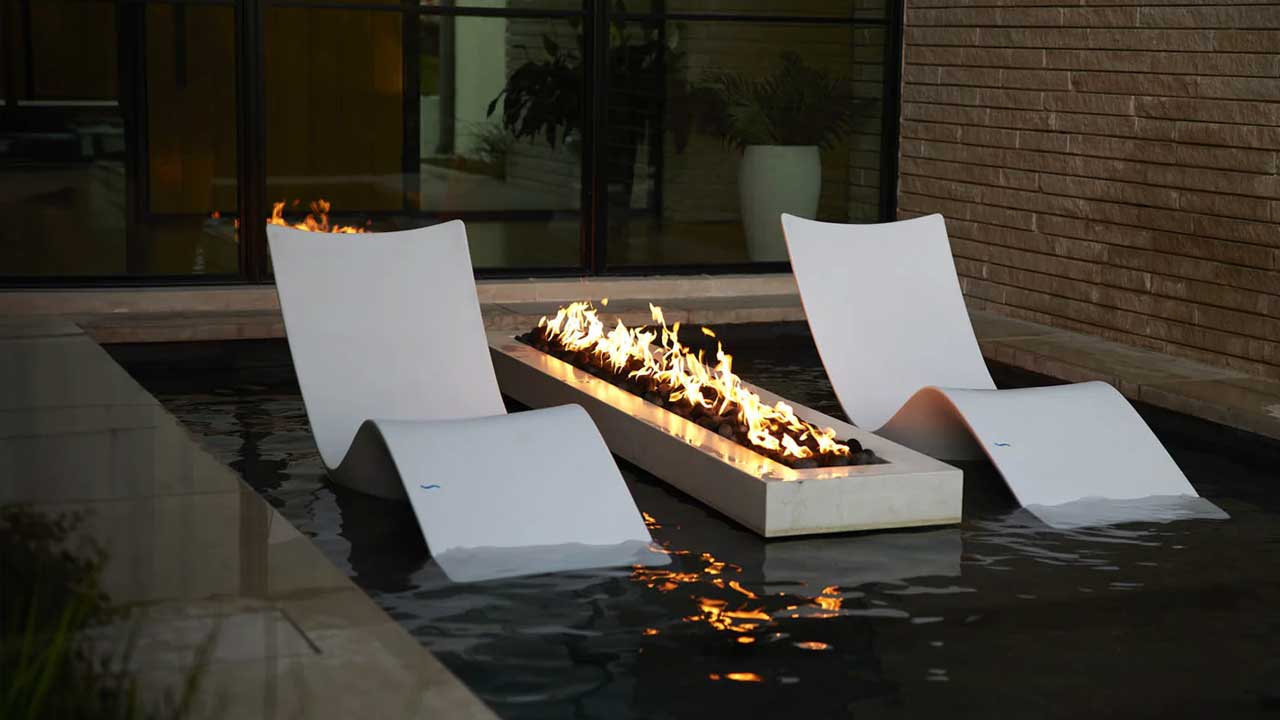
As outdoor living spaces continue to evolve into true extensions of the home, homeowners are increasingly seeking luxury, function, and style in every element of their backyard designs. This year, in-pool furniture and fire features are taking center stage as two of the most in-demand trends, transforming pool decks and sun shelves into five-star resort-style environments. To get an expert perspective, we sat down with Frank Vitori of AquaBlu Mosaics, one of the most trusted voices in poolside accessories.
2 Hot Trends for 2025: In-Pool Furniture & Fire Features
Mass Adoption of Sun Shelves Sparks an In-Pool Furniture Revolution
Frank Vitori credits the meteoric rise of in-pool furniture to the widespread popularity of the sun shelf, also known as the Baja shelf. “Over 90% of modern custom inground pools are now being built with a sun shelf,” he shared. “People have come to realize that it’s not just a stylish design element—but a shallow-water hangout zone that brings comfort, safety, and versatility to families and guests.”
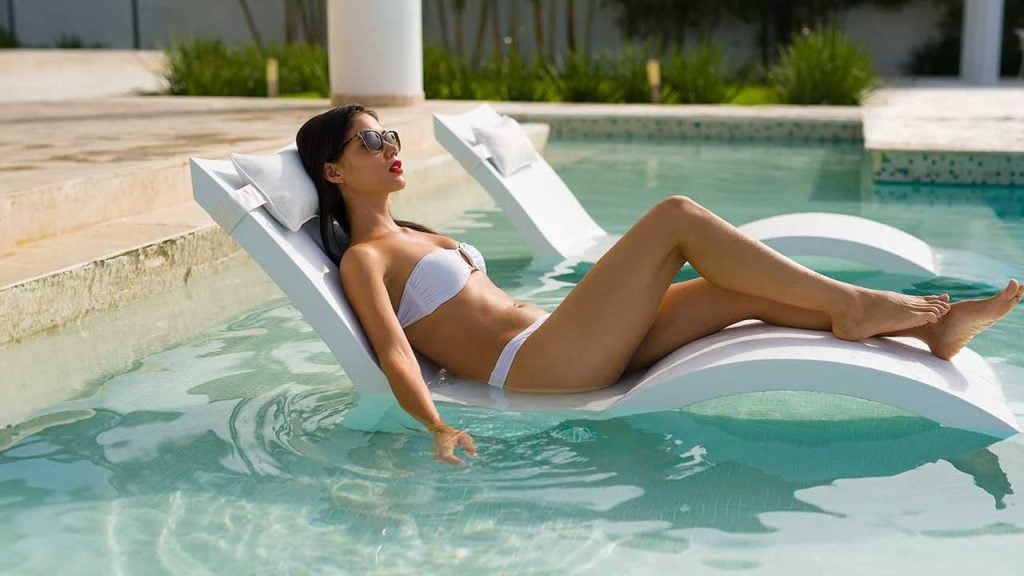
He points to industry innovators like Ledge Lounger, which helped define this category with their Signature Chaise. “I gotta give a lot of credit to Ledge Lounger and Chris Anderson for seeing the potential,” Vitori said. “They started with one chair at trade shows and now their products are part of nearly every luxury backyard.”

Following their example, brands like Floating Luxuries and Tenjam have entered the market with fresh takes. “Floating Luxuries came out with their Kai Collection, which is oversized, ergonomic, and super convenient to fill in place with a garden hose,” said Vitori. “Tenjam is another newer brand offering some exciting new designs for in-pool seating.”
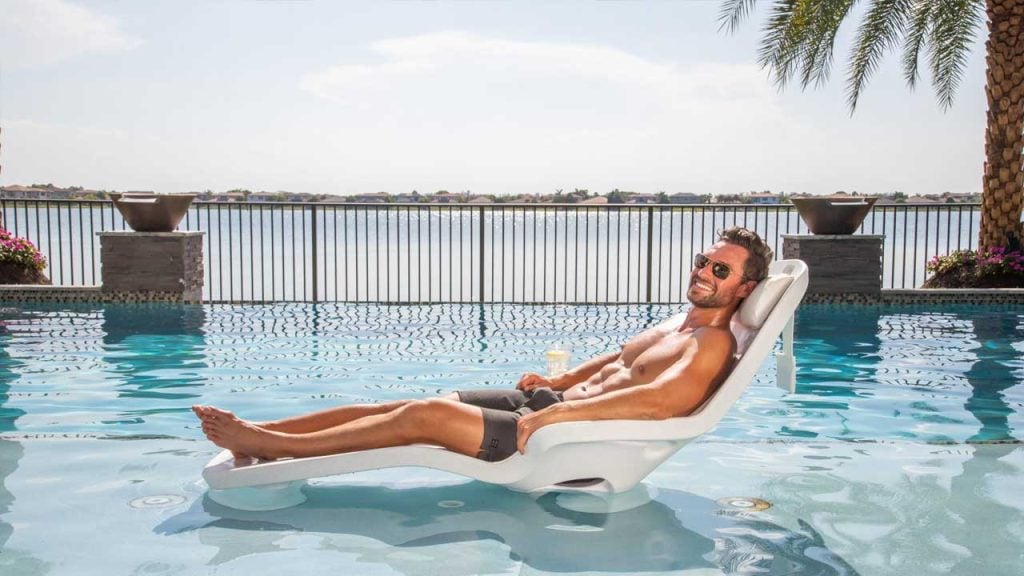
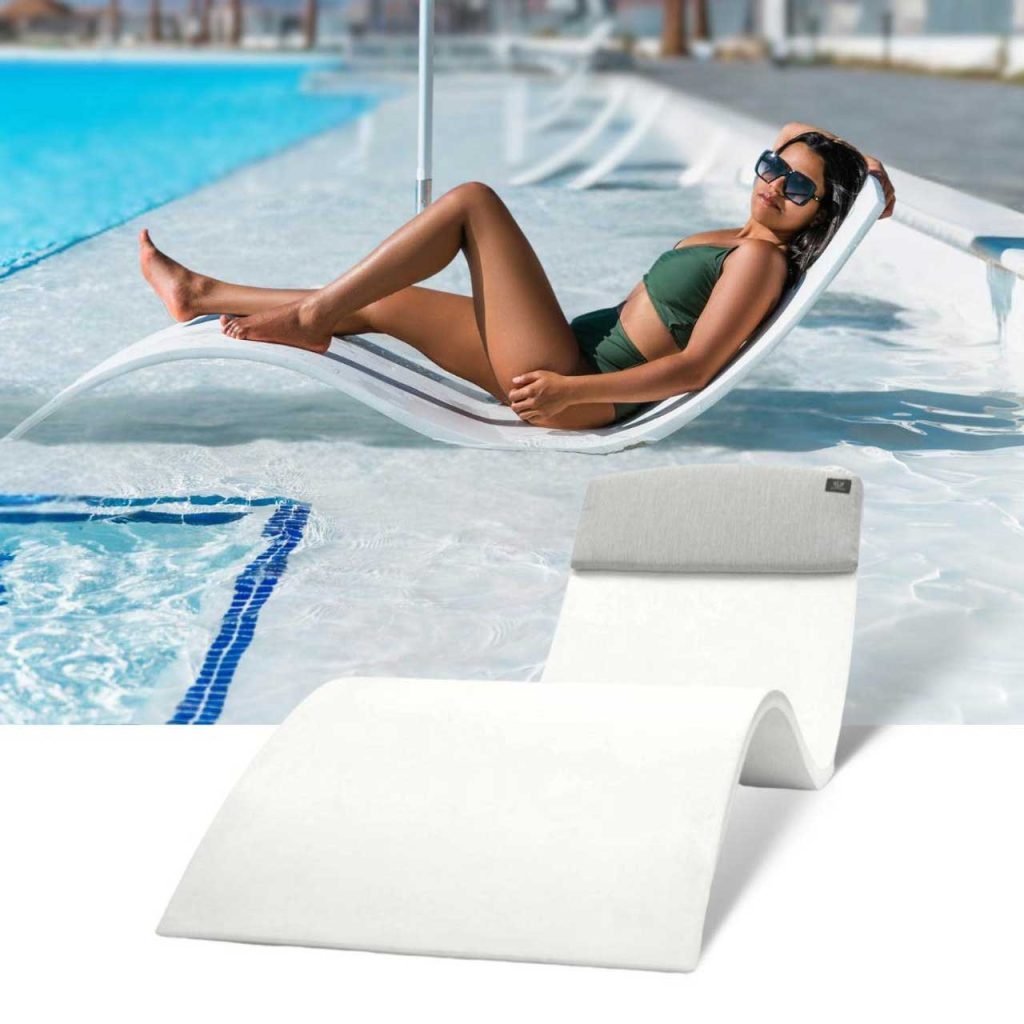
Studio Red Rock: Cast Concrete and Built to Last
One of the most distinctive product lines comes from Studio Red Rock, which specializes in cast concrete in-pool furniture. “These are heavy-duty, commercial-grade pieces that don’t need to be filled with water because they already weigh over 160 pounds,” explained Vitori. “That permanence is a big selling point for resorts and hospitality clients. Guests can’t drag the furniture around or damage it—once it’s in place, it stays put.”
Studio Red Rock’s modern silhouettes and durable finishes are turning heads, especially in high-end commercial settings and contemporary residential pools where maintenance and visual impact are both key.
Sustainable Style Makes Waves
Sustainability is also gaining momentum in the outdoor furnishings space. European-style brands like Vondom are leading the way with eco-friendly materials, such as the Ibiza Collection made from recycled ocean plastics. “There’s no reason something sustainable has to be boring or unattractive,” said Vitori. “The Ibiza Collection is a great example of that—it’s stylish, high-quality, and it’s helping clean up the ocean. That’s a win-win.”

More and more, consumers are factoring sustainability into their design decisions, especially younger buyers who want their purchases to reflect their values.

Going Beyond the Chaise
It’s no longer just about the lounger. “We’re seeing more diversity in product offerings—rockers, modular sofas, side tables, even daybeds,” said Vitori. Ledge Lounger’s Affinity Collection is one example, offering ottomans and configurable seating that adapts to the size and shape of the sun shelf.
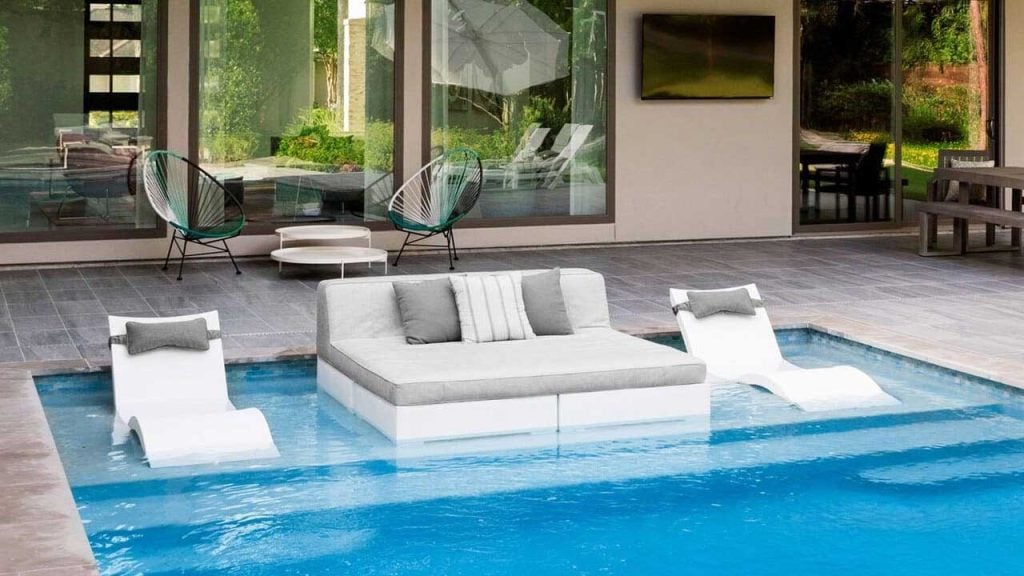
Some of the most underrated but impactful additions, according to Vitori, are accessories like tables with built-in ice buckets or umbrella holes. “It’s surprising how many people don’t realize that most in-pool furniture lines include coordinating side tables,” he said. “These tables often come with built-in ice bins and pre-drilled holes to accommodate umbrellas. That way, you’ve got a drink nearby, some shade overhead, and everything is cohesive.”
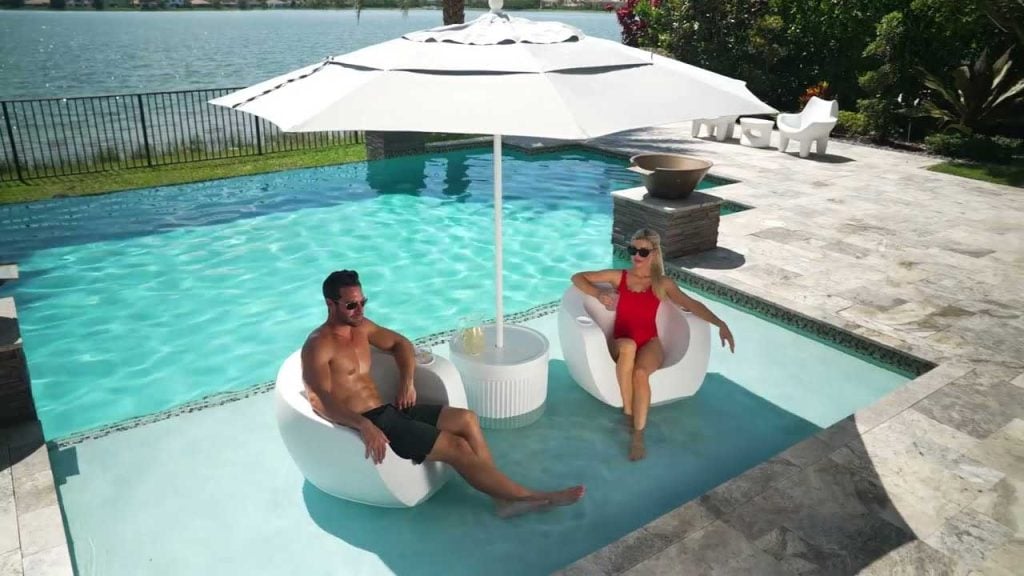
The Importance of Quality and Material
With in-pool furniture becoming a long-term investment, Vitori stresses the importance of selecting pieces made specifically for water use. UV resistance, structural stability, and chemical durability are essential. “There’s a lot of imitators out there now,” he warned. “Some of these cheaper versions you find online aren’t built for constant sun and chlorine exposure. They yellow, they crack, and they don’t hold up.”
Each brand has its own approach to water filling, anchoring, and material engineering. “Some have manual plugs, others you fill in the deep end. Floating Luxuries uses a hose and venting system that’s super easy to use. Every design has its pros and cons, so it’s worth talking to someone who knows the differences.”
Fire Features: A Focal Point of Year-Round Use
As homeowners look to make their outdoor spaces usable year-round, fire features are becoming a must-have. From compact fire pits to grand fire-and-water combinations, the market has expanded dramatically.
Vitori points to two standout manufacturers—Prism Hardscapes and The Outdoor Plus—as leaders in this category. “Prism Hardscapes specializes in GRFC cast concrete, offering that natural stone look. They’re sealed, color-through, and ready to ship,” he said.
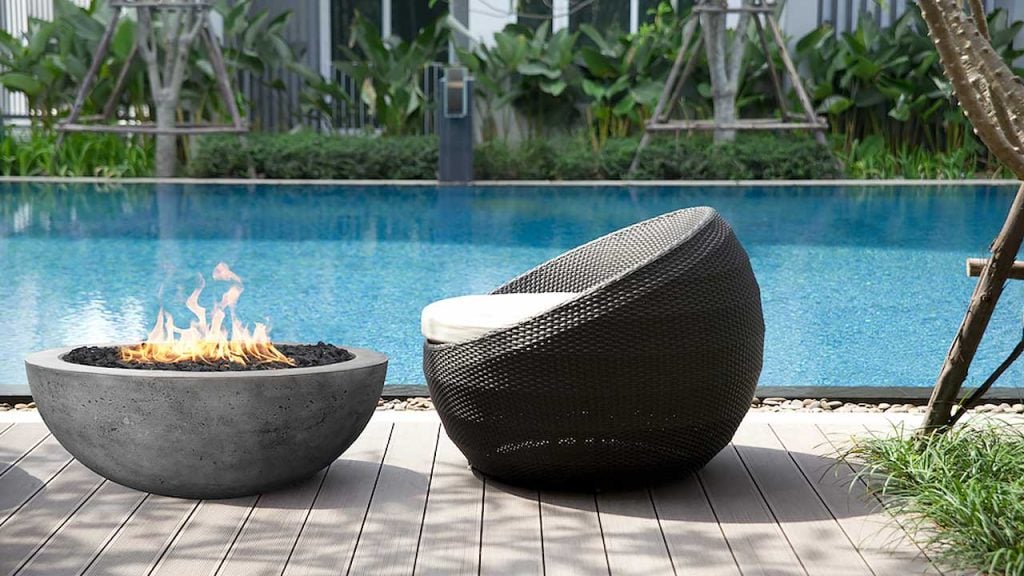
In contrast, The Outdoor Plus brings more contemporary flair, with powder-coated stainless steel and hammered copper finishes. “The copper options age beautifully over time and add a real wow factor,” noted Vitori.
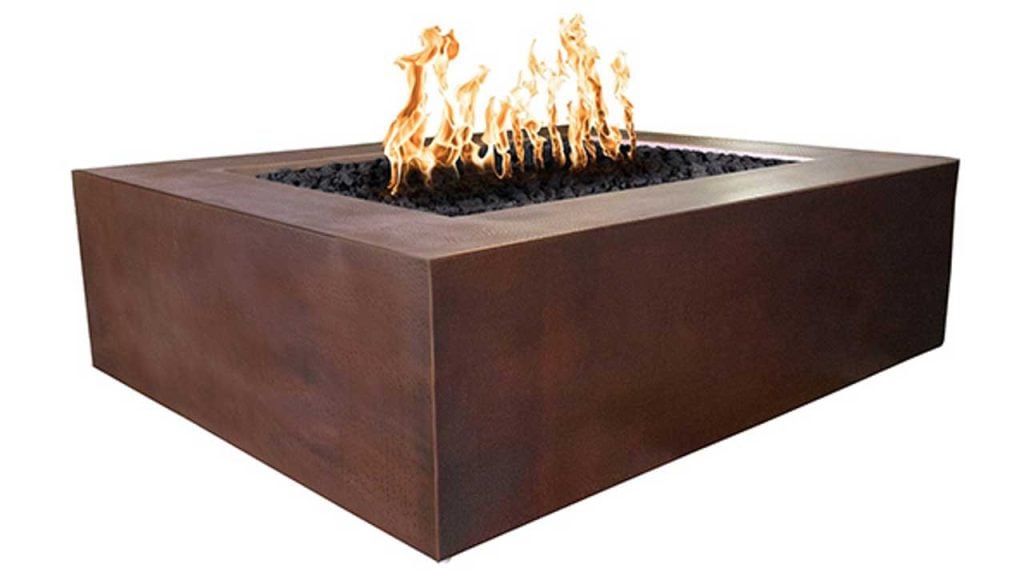
Innovative Designs Gaining Traction
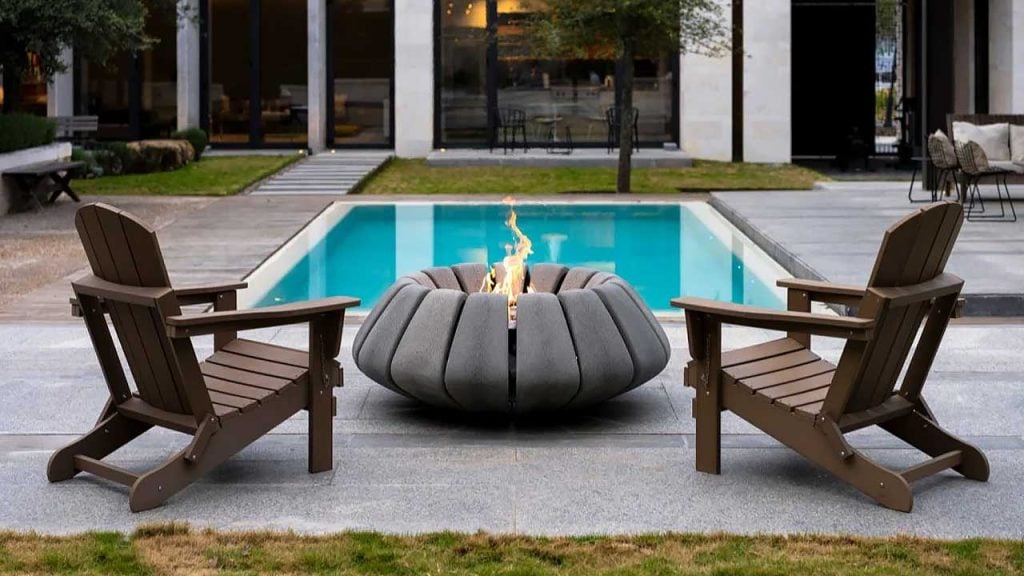
One of the more eye-catching designs to hit the market recently is Prism Hardscapes’ Sunflower Fire Bowl. “It breaks the mold—literally. It’s a sculptural centerpiece that looks incredible on modern decks,” said Vitori.
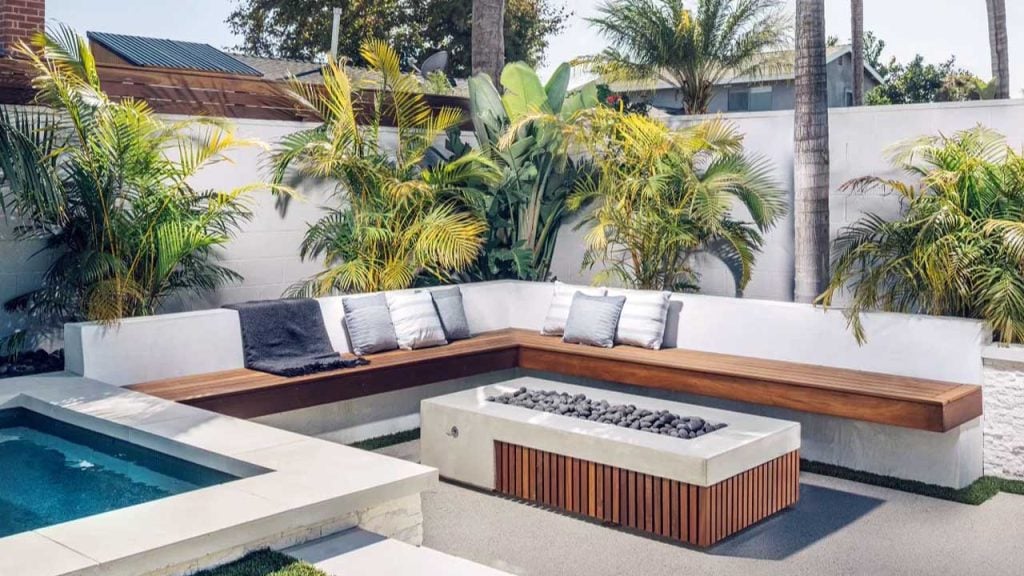
Another highlight from Prism is the Fairmont Table, which combines teak and concrete in a hybrid fire feature perfect for coastal designs.
Ledge Lounger is also making a splash with their new Halo Fire Pit, a resin-based design that includes a hidden compartment for a compact propane tank and a rotating lid. “It’s ideal for the DIY crowd. No need to plumb gas—it’s turnkey,” said Vitori.
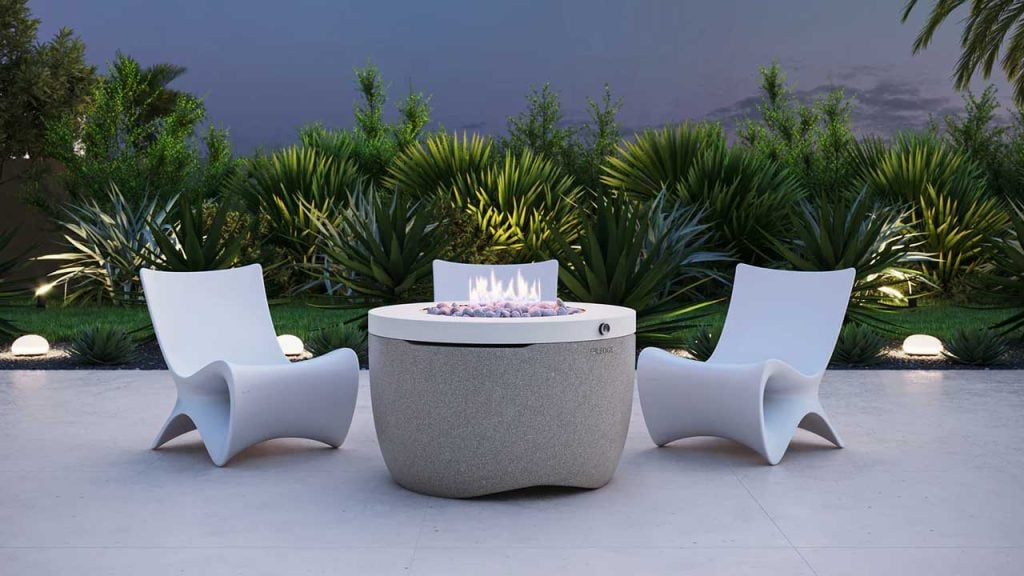
Fire & Water: A Visual Power Combo
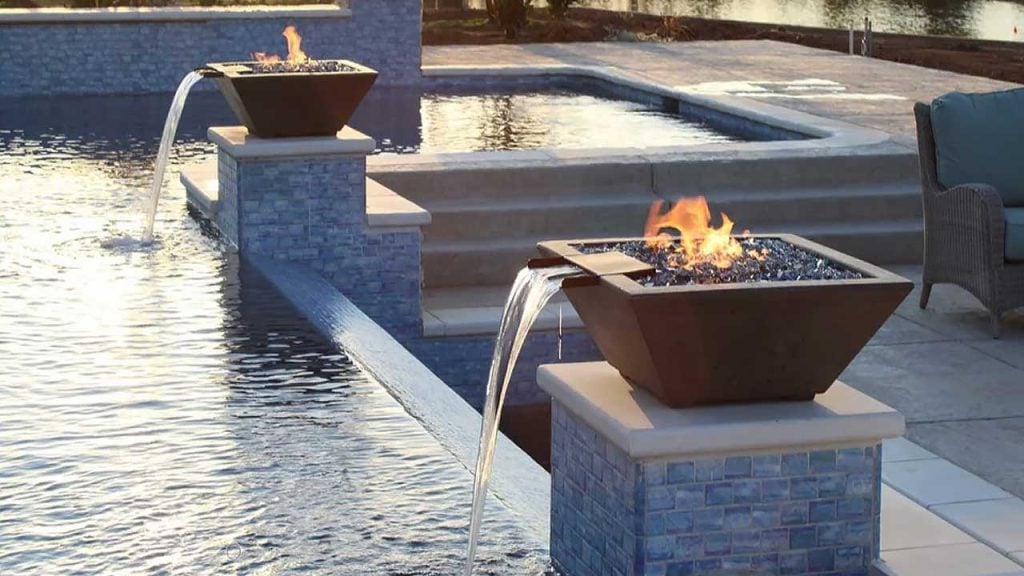
The mix of fire and water is captivating, but it requires thoughtful integration. “These are usually not DIY installations,” Vitori said. “Fire and water bowls typically go on pedestals around the pool and are installed during the pool build.”
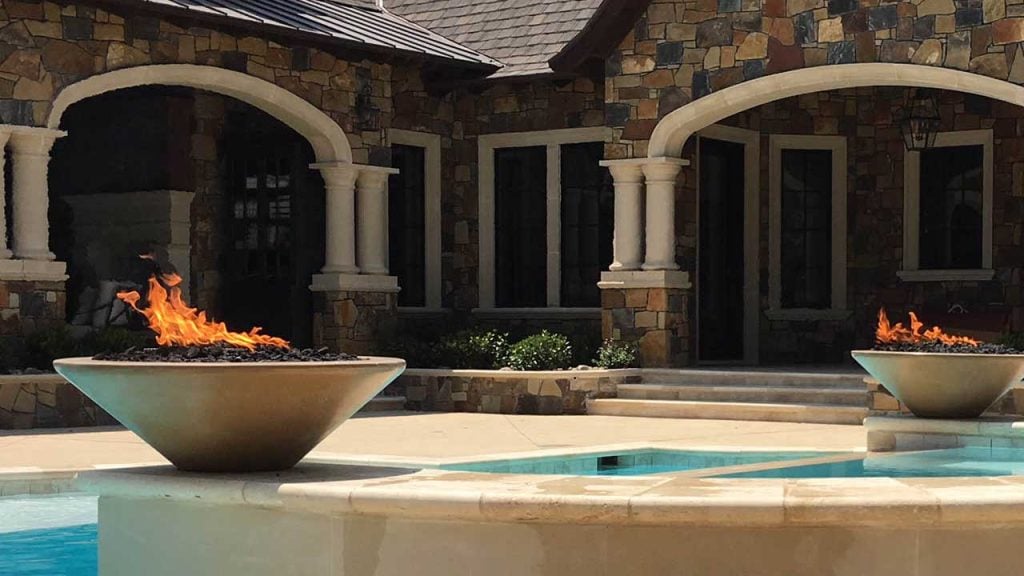
Standard models like the Cazo Bowl and Lombard are popular, but custom fabrications are on the rise. “We’re seeing more requests for 10-foot fire-and-water features, full automation, and custom pans and burner kits,” said Vitori. “Designers are pushing boundaries, and the manufacturers are stepping up to meet the demand.”
What It All Means for 2025
Fire features and in-pool furniture are more than just trendy add-ons—they’re reshaping how people live in and around their pools. “This year’s trends aren’t just about what looks good,” said Vitori. “They’re about designing for function, comfort, and usability—creating spaces that people want to live in, not just look at.”
Expect more innovation ahead as designers push for modularity, sustainability, and integration with smart systems. The modern poolscape isn’t just for summer—it’s becoming the heart of the home, all year long.
Article Photo Credits: Ledge Lounger, Tenjam, Studio Redrock, Floating Luxuries, Prism Hardscapes, The Outdoor Plus


Download the NEW Pool Magazine App

 AquatiCare™: Proactive Pool Maintenance You Can Count On
 RB Retail & Service Solutions adds DocuSign to Software
 BSquared offers New Free Standing Sunledge
 Family Leisure Announces Exclusive Retail Partnership with Jacuzzi
  Blue Wave Recall on Over 13,000 Above Ground Pools
 Tile Heritage Foundation embraces FOUR NEW BOARD MEMBERS joining the current Board of Directors!
 Coverings 2026 Previews Conference Education Ahead of Las Vegas Show

 Superior Wellness to Exhibit at Splash Expo in Australia for the First Time
 What Were The Builders Thinking With This Movable Pool Floor?
 Setting The Standard – Paolo Benedetti
 Fluidra to Acquire BAC Pool Systems
 Fiberglass Pools Look As Gorgeous As Concrete
 Thursday Pools LLC Celebrates Expansion of Manufacturing Facility and Successful Acquisition and Integration of River Pools
 EY Announces Christopher Anderson of Ledge Lounger® an Entrepreneur Of The Year® 2023 Gulf South Award Finalist
 Sponsored Advertisement
 Sponsored Advertisement
-
 Pool News2 weeks ago
Blue Wave Recall on Over 13,000 Above Ground Pools
-

 Industry News4 weeks ago
Latham Group Appoints Sean Gadd as Chief Executive Officer
-
 News3 weeks ago
Built on Relationships: Pentair Pool’s New Sales Structure and the People Who Make It Work
-

 Pool Service News4 weeks ago
Easton Select Group Adds Harrison Pool & Spa, Expanding Service Across MetroWest Boston
-

 Press Releases4 weeks ago
FSPA Wins Big at Florida Building Commission
-

 News4 weeks ago
Aquadei Technologies Announces Strategic Alliance with the Master Pool Guild
-

 Features4 weeks ago
Adopting Engineered, Reliable Pool Waterproofing Innovations — Why North America pool builders are shifting toward PVC membranes
-

 Manufacturer4 weeks ago
RicoRock® Offers New Temple Stone Firepit