


Features
Getting Pools up to date in 2025


Pool and backyard renovations are set to be a major trend in 2025. Pool professionals are anticipating a decline in new pool construction next season. Still, with millions of existing pools—many outdated in style and equipment—there’s a significant opportunity for outdoor living designers and pool professionals. By updating these pools, they can help homeowners bring their spaces into the modern era. Along with new pool liners, decking, and lighting, offering an automation system is the perfect way to integrate the latest technology into swimming pools and outdoor living areas.

Embracing automation
Backyard automation is a rapidly growing market, following the trajectory of HVAC, home security, home entertainment, and lighting automation systems within the home. If homeowners have no resistance or objection to technology, backyard automation will seamlessly integrate into their lifestyle.

Targeting a specific age bracket for selling is unnecessary, as anyone can express interest in connected automation features. Younger Gen Xers, millennials, and even baby boomers who are into gadgets seek these devices to have more control over their homes. The prominence of smart thermostats, security systems, and lighting features online and in big-box stores has significantly increased awareness.
Customers routinely inquire about pool automation, often starting the discussion by asking if there is a way to remotely control their pool water temperature. This is typically followed by questions about whether there is an app for that. Most clients are primarily interested in controlling their heaters, pool lights, and water chemistry. Customers have also expressed the desire to control multi-port valves to enable water features and have a general understanding of what is happening at the pool when they are away. They have also expressed a general sense of consumption, such as how much energy and water is consumed, corroborating that with monthly water and electricity bills.
The smartphone has driven the consumer’s desire to control all the elements of their home from anywhere, all in the palm of their hand. Exterior landscape lights, pool lights, hot tubs, pool temperatures, and control over pool and hot tub water chemistry are all manageable through mobile devices. Providing simple automation helps ensure client satisfaction by offering a trouble-free, easy-to-maintain pool. Automation simplifies the maintenance of the homeowner’s backyard, allowing pool owners to ensure the pool is managed correctly without having to go outdoors to check before bed.
One common obstacle is understanding what part of the equipment pad is automated and how the automation system enhances the equipment it is connected to. Other things include comfort with technology and using the smartphone app associated with automation systems. A question that might need to be asked is, “Are there other devices that might impede the automation system (e.g. an old-school time clock)?” Finally, just because the pool equipment is now automated does not mean all issues are solved, so monitor the equipment and its performance.

Simple solutions

The benefits of backyard automation include enabling remote control over various aspects of the outdoor living space, providing alerts and updates in case of malfunctions, and analyzing multiple systems in detail. Simpler automation systems tend to be the most effective for most customers. Intuitive, easy-to-operate systems are key to keeping customers happy. These systems must offer enough features to satisfy the homeowner’s needs while remaining simple enough to avoid requiring technical support after installation.
Fortunately, control system interfaces have become more user-friendly, even as their capabilities expand. Understanding a client’s routine and preferences allows professionals to offer solutions tailored to their needs. While many customers are technologically savvy, most rely on trusted outdoor living/pool and hot tub experts to help them comprehend and recommend optimal solutions for modernizing their pool.
Some of the best ways pool professionals can stay current with automation technology are through tradeshows, trade magazines, working with local sales reps, equipment manufacturers, and even customers. These are great ways to stay abreast of all the new developments in automation.
The trend toward smart homes has accelerated, fueled by increased time spent at home, boosting demand for home networking, entertainment, and environmental control systems. This shift has also driven the growth of outdoor living spaces, with homeowners seeking backyard resorts. Automation and modernization are now inextricably linked.

Modernizing with automation offers cost-saving benefits
Automation simplifies chores associated with pool and hot tub ownership and brings cost-saving benefits. Timers for outdoor and pool lights help reduce electricity costs, as does regulating pool and spa water temperatures. Automated pool and hot tub water chemistry dosing and control prevent overdosing or imbalance, minimizing the need for excessive chemical use and reducing overall expenses. Maintaining balanced pool water chemistry is especially critical for plaster pools, as unbalanced chemistry can lead to costly repairs.
Automation allows one to react to a pool’s water chemistry needs quickly. Whether there is a change in pH or chlorine levels, automation systems can promptly address the pool’s needs and can be adjusted remotely. This takes the waiting for a service professional to come and test out of the equation. Automation systems that can read pH and oxidation-reduction potential (ORP) levels will be best suited because they can gauge and give readings, subsequently dosing when needed.
Many clients with salt chlorine generators often experience issues when their salt system shuts down due to pH imbalances in the pool water. This problem typically arises because improper pH levels lead to scale build-up on the salt cell assembly, which causes the chlorine generator to shut off.
A pH automation controller can be installed to measure and dose the pool water to address this issue, ensuring proper pH levels are maintained. A compact, user-friendly pH controller with app-based notifications is ideal, as it alerts users when the water goes out of range, allowing for necessary adjustments.
Many pool professionals agree that automation systems can help avoid problems that increase a pool’s operating costs. While automation doesn’t replace regular service, systems like chemical controllers and feeders ensure all systems function correctly between service calls.
Service professionals can enhance the service they provide. By not only having more access to real-time equipment status and remote access in some cases, service professionals can get information on their routes and pools before time, meaning that each service call is more meaningful and impactful. Additionally, with monitoring services, service professionals can provide customers with a higher level of personalized, premium service that goes beyond standard expectations, not only upselling opportunities but also strong customer relations.
There still need to be maintenance checks on equipment and chemical refills (UberEats for chemicals is not ready just yet!), and perhaps just general visual checks on the pool, but it does cut down on time, and with more time, more pools are serviced.
Automation systems also provide valuable data, enabling service professionals to identify issues, such as pH imbalances or malfunctioning lights, before they escalate. This proactive approach gives service companies a competitive advantage by allowing for more specific discussions with clients rather than general inquiries about backyard conditions.

Customer satisfaction
Many pool professionals agree that offering and installing simple automation systems helps modernize pools for customers while differentiating their businesses from competitors. Automation can be a game-changer for independent pool and spa professionals. In addition to upgrading pools, automation fosters customer loyalty by empowering clients with greater control and enhancing their sense of ownership over a more modern pool experience.
As mentioned, it also allows for a deeper understanding of what is happening with the customer’s equipment and distant visibility. Technically, an automation system almost gives the client’s pool constant monitoring and care capabilities around the clock. Additionally, contract provisions could allow this monitoring to be down to an additional dollar figure. The author has seen service professionals offer equipment upgrades and monitoring components, which has been an excellent driver of top-line revenue for them.
Offering pool automation boosts customer satisfaction and excitement about their backyard investment. These systems simplify pool maintenance and make operating other components easier, even remotely. Automation enhances the backyard experience with features like colourful lighting, optimal water temperature, and chemistry when clients jump into their pools.
Now is the perfect time for pool and hot tub professionals to consider offering simple backyard automation. The off-season is ideal for exploring new automation systems so professionals can modernize their clients’ pools in 2025.


Features
Adopting Engineered, Reliable Pool Waterproofing Innovations — Why North America pool builders are shifting toward PVC membranes


If reinforced PVC membranes are such a technically sound and long-lasting waterproofing solution, the obvious question is:
Why aren’t they everywhere — especially in North America, the largest pool market in the world?
The answer lies in how American pools have traditionally been designed and built, and how that tradition has slowed the adoption of more engineered, reliable solutions — even when the performance benefits are clear.
A Legacy of Shape Over Function

One of the defining features of the North American residential pool market — especially since the 1950s — has been its love for freeform pool shapes. Curved, kidney-shaped, lagoon-style, and organically sculpted designs have dominated backyards across the U.S. for decades.
These shapes lend themselves well to gunite construction, which allows complete freedom in form and finish. But they pose a unique challenge for reinforced PVC membranes, which are supplied in rolls, custom-fitted on site by heat-welding and engineered for durability — but not extensive stretch.
Unlike flexible vinyl liners that can be vacuum-formed into irregular curves, reinforced PVC membranes are dimensionally stable and have minimal elasticity, one of the very features that makes them last so long. But that strength and rigidity also means they are best suited to smooth rectilinear shapes or pools with consistent radiuses and defined transitions.
For decades, this technical limitation restricted the adoption of reinforced membranes in a market dominated by complex, curvy pool forms — particularly in suburban residential builds.

Innovation Slow to Enter the U.S. Market

The North American pool industry has long been rooted in tried-and-true construction models that haven’t changed significantly since the 1940s. In fact, many pools built today still follow the same basic layout and methodology as the first post-war gunite pools:
Concrete shell, plumbing, plaster or tile finish — and little focus on true waterproofing as a separate function.
Meanwhile, European and other international markets, where space constraints and design culture favor cleaner, rectilinear architecture, have embraced reinforced membranes for decades. These regions have led in implementing engineered materials that decouple waterproofing from the structural shell, treating it as a specialized discipline rather than a side effect of the surface finish.
As a result, the U.S. market has largely lagged behind the evolution of reliable, low-maintenance, physics-based waterproofing methods — particularly in the residential sector.
A Building Culture Reluctant to Change — Until Now
Much like other mature industries, the North American pool market has historically been resistant to change, particularly when existing methods are familiar, profitable, and understood by local contractors. However, the tide is turning — thanks to shifting consumer expectations and a new generation of builders and homeowners.
Younger, more informed clients are beginning to ask different questions:
- “What actually makes this pool waterproof?”
- “Why do I need to replaster after a few years?”
- “What will last 20+ years without constant repairs?”
At the same time, builders are becoming more open to physics-first solutions — systems that are engineered to solve specific problems, not just following decades of precedent. That includes better understanding of water pressure, vapor migration, freeze-thaw cycles, and the chemical realities of long-term pool operation. Reinforced PVC membranes provide a waterproofing pool finish with unique benefits not provided by marbelite, stone-colored quartz finishes or thermoplastic coating. The reinforced PVC completely seals the structure of the pool and keeps it watertight, making it ideal for renovating existing pools and building new pools.
Gary Hohne, owner of Brighton Pools was born into the pool and spa industry. His father became a builder of vinyl liner pools in 1954, following the introduction of package pools construction in the industry. Hohne has been in the pool building business his entire life. “This is the only job and industry I’ve even been in,” he chuckles. Originally, his father owned Hohne Pools and more recently Hohne Jr. started a franchise of pool builders called Brighton Pools by Hohne which now has franchises in Maryland, Virginia, West Virginia, Pennsylvania, New Jersey, New York, Delaware, North Carolina, Florida and Tennessee! “Having a family swimming pool business that started 7 decades ago, I have watched the US market for swimming pools evolve over the years and I’m thrilled to have added reinforced PVC membranes to our residential pool construction options.”

Originally Hohne got started with reinforced PVC membrane with commercial pool renovations. “The first reinforced PVC membrane pool we renovated was Constitution Park in Cumberland, Maryland. “The pool at Constitution Park was built in the 1930’s and we completely renovated this 550,000-gallon pool with reinforced PVC membrane,” explains Hohne. “Back then we only used reinforced PVC membrane in commercial applications but in the last 5 years decided to train crews to install this membrane so we can offer to waterproof both new and existing swimming pools with a finish that will last 20 years or more; there is definitely a market of consumers who don’t want to have to repaint, replaster or change their pool liner out in 10 years to less—for them, this product is the ideal solution,” says Hohne.
Brighton Pools sees that reinforced PVC membrane is a waterproofing pool finish that works for both new pool constructions as well as renovation. “Consumers are savvy and many of them would prefer not to have to replace their vinyl pool liner every 10 years or need to replaster or re-paint their pool,” says Hohne. “These consumers are willing to pay more for a reinforced PVC membrane that will last more than 20 + years and we realized this and decided that we wanted to start offering reinforced PVC for residential pools and it has been highly successful.” One of the other reasons that Hohne’s company decided to add reinforced PVC to his offering is that it is the ideal solution for renovating all types of pools. Not only for repair and renovation but also as a complete waterproofing solution. “Whether we get a call to renovate a deteriorated gunite pool, or a plaster finish pool or a traditional vinyl liner, we offer reinforced PVC membrane because we know the reinforced PVC membrane will provide a complete waterproofing solution,” says Hohne. “We also know that these pool owners are likely looking for a long-term solution and are willing to pay for a reinforced membrane so they don’t need to deal with cracked or crumbling pool walls, peeling paint, falling tiles etc.” In fact, Hohne says that every quote they provide always includes a line for reinforced PVC membrane as an option because so many people are now opting for this more permanent solution. Hohne is continuing to expand franchise operations throughout the country and he knows that reinforced PVC membranes are an important part of the company’s growth. “As more and more people are trained to install reinforced PVC membranes, the more we will see reinforced PVC membranes catching up to their level of popularity in Europe.”

Design Trends Are Catching Up to the Material
Importantly, pool design itself is changing. Modern residential pools in North America —particularly in architecturally progressive markets like Miami, Austin, and Los Angeles — are starting to follow European-influenced trends: minimalism, linear geometry, clean edges, and symmetry.
These modern forms are ideally suited for reinforced PVC membranes, which are easier to fabricate and install in rectilinear or predictable geometries. As more homeowners seek out elegant, modern pools with lower maintenance, the case for reinforced PVC membranes becomes even more compelling.
For example, Plunge pools are a category of pool that has grown exponentially in recent years. And because of their shape and size, they lend themselves perfectly to reinforced PVC membrane. Bob Hobaica, owner of Plunge+ pools (part of Easton Select Group) honed-in on reinforced PVC as a superior, waterproofing interior for their plunge pool. “I had read several articles about reinforced PVC for use in pools over the past few years and talked to installers who actively use this finish in commercial pools,” explains Hobaica. “So when RENOLIT approached me, I was receptive to learning if this waterproofing pool interior solution would work for the Plunge+ pool.” Now Plunge+ pools are constructed using reinforced PVC membrane as its method of waterproofing and finishing the pool. “RENOLIT initially came out and trained our construction crew on how to install reinforced PVC,” explains Hobaica. “There is a bit of a learning curve to the installation. However, we were all super impressed with the durability and practicality of the product, not to mention that the company’s new TOUCH textures and colors are very attractive to consumers.”
In short: the market is finally catching up to the material.
Looking Forward: A Bright Future for Reinforced PVC in North America
The next decade will likely see a major shift in how North American pools are waterproofed and finished. The demand for durable, low-maintenance, and high-performance materials is rising. The industry’s younger generation is more open to physics-driven construction. And modern pool shapes are opening the door for solutions that weren’t viable in decades past.
Reinforced PVC membranes — with their 40+ years of proven performance across Europe, commercial installations, and high-end projects — are finally finding their place in the North American residential market.
As the focus moves from simply building pools to engineering them properly, reinforced membranes are not just an option — they’re part of the future.

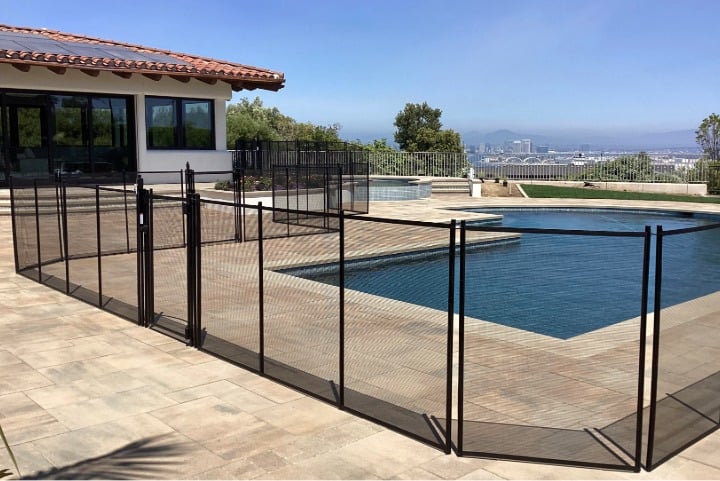
Poolsafe LLC, offers new mesh, removable safety fencing designed to be installed around any pool shape or size. Uses patented, transparent, large-hole ClearGuard™ Mesh for better visibility into the pool area, while also blending the fence into backyard. Lockable, self-closing Triton™ gate features a curved top bar to help prevent climbing. Unique Tri-Pod Truss system keeps gate aligned with daily usage. Available in 4ft and 5ft heights, in black, brown, beige, or gray colors.
https://poolsafe.com/
(888) 489-2282


The newest addition to the Temple Stone series, this new firepit is made of attractive and safe pre-cast lightweight concrete that matches the latest in outdoor living décor. Roughly 18”-inches high, 76” long and 23” wide, the Temple Stone firepit makes it easy to create a gathering space in any backyard. Hooks up to standard propane tanks. Shown in limestone color. Made in USA and available for immediate shipment.
www.ricorock.com or call (888) 717-3100.


Download the NEW Pool Magazine App
 Sponsored Advertisement
 AquatiCare™: Proactive Pool Maintenance You Can Count On
 RB Retail & Service Solutions adds DocuSign to Software
 BSquared offers New Free Standing Sunledge
 Family Leisure Announces Exclusive Retail Partnership with Jacuzzi
  Blue Wave Recall on Over 13,000 Above Ground Pools
 Tile Heritage Foundation embraces FOUR NEW BOARD MEMBERS joining the current Board of Directors!
 Coverings 2026 Previews Conference Education Ahead of Las Vegas Show

 Amurjo Natural Pool: The Longest Pool in Europe
 New Poolsafe Removable Mesh Safety Fences
 Pool & Hot Tub Alliance Unveils Updated Strategic Plan To Elevate Industry Standards And Drive Growth
 A Frank Lloyd Wright Inspired Pool Renovation, Behind The Collaboration Curtain
 GPS Trackit Launches New E-Commerce Platform
 Latham Group, Inc. Expands to Loyalist Township in Canada with New Fiberglass Manufacturing Plant
 Regulating Humidity in Indoor Pools
 Sponsored Advertisement
 Sponsored Advertisement
-
 Pool News2 weeks ago
Blue Wave Recall on Over 13,000 Above Ground Pools
-

 Industry News4 weeks ago
Latham Group Appoints Sean Gadd as Chief Executive Officer
-

 News3 weeks ago
Built on Relationships: Pentair Pool’s New Sales Structure and the People Who Make It Work
-

 Pool Service News4 weeks ago
Easton Select Group Adds Harrison Pool & Spa, Expanding Service Across MetroWest Boston
-
 Press Releases4 weeks ago
FSPA Wins Big at Florida Building Commission
-

 News4 weeks ago
Aquadei Technologies Announces Strategic Alliance with the Master Pool Guild
-

 Features4 weeks ago
Adopting Engineered, Reliable Pool Waterproofing Innovations — Why North America pool builders are shifting toward PVC membranes
-

 Manufacturer4 weeks ago
RicoRock® Offers New Temple Stone Firepit
as
Need a People for w0rk
Make extra profit every week… This is a great part-time job for everyone… Best part about it is that you can work from your home and earn from 100-2000 Dollars each week .….. Start today and have your first payment at the end of the week…
rebrand.ly/joincashapp1